The Psychology of User Onboarding: What Makes Users Stick
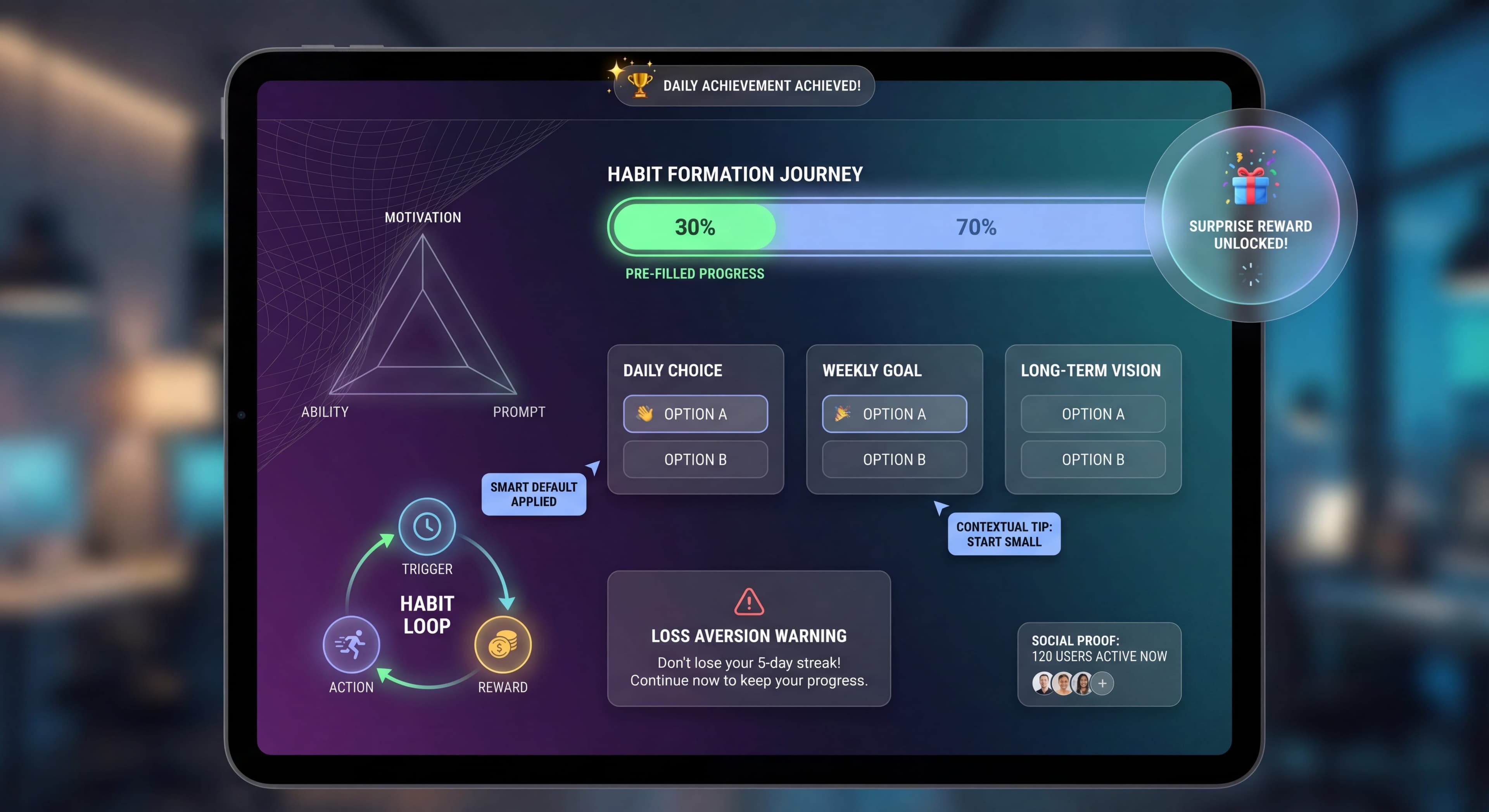

Great onboarding isn't just about showing users where to click. It's about understanding how people actually think, feel, and make decisions. The most effective onboarding draws on psychological principles that researchers have studied for decades.
This guide explores the psychology behind user engagement and how to put it to work in your onboarding.
Users dropping off early?
Create step-by-step guides that motivate users to complete onboarding with Glitter AI.
The Fogg Behavior Model
BJ Fogg's behavior model states that for any behavior to occur, three elements must converge at the same moment:
Behavior = Motivation + Ability + Prompt
If any element is missing, the behavior won't happen.
Motivation
Motivation is the psychological energy that drives users toward action. While ability concerns what users can do, motivation is about what they want to do. Users need to genuinely want to complete onboarding tasks. BJ Fogg's research identifies three core motivators, each operating along a spectrum from positive to negative.
Seeking pleasure and avoiding pain is probably the most fundamental motivator. In onboarding, users seek the pleasure of solving their problem: more productivity, better outcomes, less stress. At the same time, they're escaping the pain of their current unsolved challenge. Effective onboarding taps both sides by reminding users of the pain they came to escape while showing glimpses of the relief your solution provides. Don't assume users remember their motivation after signing up. Explicitly reconnect them to the problem they came to solve.
Seeking hope while avoiding fear pushes users toward promising futures while pulling them away from uncertain outcomes. Users sign up hoping your product will change their situation. But they also fear the effort required, the possibility of failure, or the risk of making the wrong decision. Onboarding needs to amplify hope through quick wins and visible progress while minimizing fear through simple early tasks and obvious paths forward. Show users they're succeeding and capable, not struggling and at risk.
Seeking acceptance and avoiding rejection reflects our social nature. Users want to belong, to be part of successful groups, to make choices that others validate. Social proof during onboarding ("Join 10,000+ teams" or "Teams like yours use this for...") taps into acceptance motivation. Minimize rejection fears by showing users they're making smart choices that others have validated.
Practical Onboarding Applications:
Remind users immediately why they signed up, connecting to the specific problem they came to solve rather than generic value statements. Show clear rewards for completing setup ("After this 2-minute setup, you'll be able to...") making the effort-to-reward tradeoff obvious. Create social proof throughout onboarding showing others like them successfully using your product. Reduce anxiety about difficulty through progress indicators, time estimates, and skip options that lower perceived commitment.
Ability
Users must be capable of taking action. Ability is about simplicity:
- Time: How long does it take?
- Money: What's the cost?
- Physical effort: How hard is it?
- Mental effort: How much thinking required?
- Social deviance: Does it go against norms?
- Routine: Does it disrupt existing behavior?
Onboarding application:
- Reduce steps to minimum
- Provide clear instructions
- Eliminate decision points
- Use familiar patterns
- Remove friction
Prompt
Users must receive a trigger at the right moment.
Types of prompts:
- Spark: Motivates behavior (when ability is high but motivation is low)
- Facilitator: Makes behavior easier (when motivation is high but ability is low)
- Signal: Simple reminder (when both motivation and ability are high)
Onboarding application:
- Use contextual triggers based on behavior
- Send reminders at appropriate times
- Make CTAs obvious and clear
The Hook Model
Nir Eyal's Hook Model describes how products create habits through a four-phase loop:
1. Trigger
External triggers: Notifications, emails, CTAs
Internal triggers: Emotions, situations, thoughts
Onboarding application:
- Start with external triggers (emails, in-app prompts)
- Associate product with internal triggers (bored? check feed)
- Teach users when to think of your product
2. Action
The simplest behavior in anticipation of reward.
Onboarding application:
- Make first actions incredibly easy
- Reduce friction to near-zero
- One-click, immediate value
3. Variable Reward
Unpredictable positive outcomes keep users engaged.
Types of rewards:
- Rewards of the tribe: Social validation
- Rewards of the hunt: Information, resources
- Rewards of the self: Mastery, achievement
Onboarding application:
- Celebrate completions unpredictably
- Show progress and achievements
- Reveal value gradually
4. Investment
Users put something in that improves future experience.
Onboarding application:
- Encourage data entry, customization
- Prompt inviting teammates
- Build switching costs through investment
Progress and Achievement
The Endowed Progress Effect
The endowed progress effect reveals something counterintuitive: people show much higher completion rates for tasks when they believe they've already made progress, even if that progress is artificial. Perception of advancement matters more than actual distance to goal. This has real implications for onboarding design.
The Classic Study:
Researchers ran a simple experiment with two versions of a car wash loyalty program. One group got cards requiring 8 stamps to earn a free wash, starting at 0 of 8. The second group got cards requiring 10 stamps but started with 2 already filled (showing 2 of 10). Both groups needed 8 car washes to complete. But the pre-stamped group finished their cards at dramatically higher rates, roughly 82% versus 19%.
Why such a big difference when the real requirements were identical? The pre-stamped group felt they'd already invested in the goal. This perceived advancement created psychological momentum. Starting at 2 of 10 felt like continuation rather than beginning, lowering the barrier to commitment. The sunk progress made abandonment feel wasteful rather than just choosing not to start.
Onboarding Applications:
Start progress indicators with some built-in completion instead of zero. Rather than "0% complete" when users arrive, show "Setup 30% complete, account created" or similar language acknowledging their signup as meaningful progress. This simple reframe dramatically increases completion by making users feel they've already invested.
Show users what they've accomplished even in the earliest moments. After signup, celebrate explicitly: "Great start! You've created your account and are ready to begin." This turns signup from a simple step into recognized achievement. Frame remaining setup as continuation: "You're almost done, just 2 more quick steps" feels more manageable than "Complete these 5 setup tasks."
Think about your entire funnel through this lens. Each completed step becomes progress to acknowledge, creating momentum toward the next action. Users who've completed 3 of 5 onboarding tasks feel much more committed to finishing than users starting fresh, even though only 2 tasks remain either way. Structure onboarding to create and celebrate progress at every step.
The Goal-Gradient Effect
Effort increases as people approach their goal. The closer to completion, the faster they work.
Onboarding application:
- Show clear progress toward finish
- Make end goal visible
- Create anticipation for completion
Completion Psychology
Unfinished tasks create mental tension (Zeigarnik Effect). People remember and are drawn to complete unfinished tasks.
Onboarding application:
- Show incomplete checklists
- Indicate unfinished setup
- Create visible open loops
Social Proof and Belonging
Social Proof
People look to others' behavior to guide their own, especially in uncertain situations.
Types of social proof:
- User numbers: "Join 10,000+ teams"
- Testimonials: "Here's what users say"
- Similar users: "Teams like yours use..."
- Expert endorsement: "Recommended by..."
- Real-time activity: "Sarah just completed..."
Onboarding application:
- Show usage statistics
- Display testimonials during signup
- Show activity from similar users
- Celebrate milestones others have reached
Belonging and Identity
People are motivated by group membership and identity alignment.
Onboarding application:
- Help users identify with successful user personas
- Create community connection
- Show users they belong ("You're one of us now")
Loss Aversion
The Principle
People feel losses more strongly than equivalent gains. Losing $100 feels worse than gaining $100 feels good.
Application to Onboarding
Invested effort:
- Once users put work in, they don't want to lose it
- Encourage early investment (data, customization)
Trial psychology:
- Framing trial end as "losing access" vs. "not buying" changes behavior
- Show what they'll lose, not just what they'll gain
Setup investment:
- "You've already completed 3 steps" creates loss aversion around abandoning
Commitment and Consistency
The Principle
Once people commit to something (especially publicly), they feel compelled to act consistently with that commitment.
Knowledge stuck in silos?
Create step-by-step guides that share expertise across your entire team with Glitter AI.
Application to Onboarding
Micro-commitments:
- Small early commitments lead to larger ones
- "Would you like to continue?" gets yes before bigger asks
Stated intentions:
- Asking users their goals creates commitment to those goals
- "What do you want to accomplish?" prompts follow-through
Public commitment:
- Inviting teammates makes commitment public
- Shared workspaces create accountability
Cognitive Load and Choice Architecture
Cognitive Load
Working memory is limited. Overload leads to paralysis and abandonment.
Types of cognitive load:
- Intrinsic: Complexity of the task itself
- Extraneous: Poorly designed interface adding load
- Germane: Effort of learning and integration
Onboarding application:
- Reduce extraneous load through good design
- Spread intrinsic load across time
- Support germane load with clear instruction
Choice Overload
Too many options leads to decision paralysis and reduced satisfaction.
Classic study: 6 jams vs. 24 jams. More options led to fewer purchases.
Onboarding application:
- Limit options at each step
- Provide recommended paths
- Default to common choices
- Reveal complexity progressively
Default Effects
People tend to accept defaults. Whatever you make default is what most will choose.
Onboarding application:
- Choose defaults wisely
- Default to success-driving options
- Require opt-out, not opt-in, for beneficial features
Feedback and Reinforcement
Immediate Feedback
Behavior followed quickly by consequence is more likely to be learned.
Onboarding application:
- Respond to actions immediately
- Celebrate completions instantly
- Show impact of user actions
Positive Reinforcement
Rewards increase likelihood of repeated behavior.
Types of reinforcement:
- Continuous: Every instance rewarded (early onboarding)
- Variable: Random reward (ongoing engagement)
Onboarding application:
- Celebrate every early win
- Transition to variable reinforcement for habits
Progress Feedback
People need to know they're moving forward.
Onboarding application:
- Progress bars
- Step indicators
- Success messages
- Milestone markers
Knowledge stuck in silos?
Create step-by-step guides that share expertise across your entire team with Glitter AI.
Practical Applications
Welcome Experience
Apply:
- Social proof (user numbers, testimonials)
- Progress framing (welcome, let's get you set up)
- Clear next action (single CTA)
- Motivation reminder (here's what you'll achieve)
Setup Process
Apply:
- Endowed progress (step 1 of 4, already started)
- Commitment through action (small asks first)
- Loss aversion (don't lose your work)
- Cognitive load management (few choices per step)
First Value Moment
Apply:
- Immediate feedback (instant results)
- Variable reward (delightful unexpected touches)
- Achievement recognition (celebration)
- Social proof (others find value here)
Ongoing Engagement
Apply:
- Hook model (trigger → action → reward → investment)
- Habit formation (consistent timing)
- Progressive commitment (increasing investment)
- Identity reinforcement (you're a power user now)
Designing with Psychology
Do:
- Design for real humans with limited attention, emotions, and competing priorities
- Test assumptions about what motivates your specific users
- Use psychology ethically to help users achieve their goals
- Respect autonomy even while guiding behavior
Don't:
- Manipulate against users' interests
- Create dark patterns that exploit psychology
- Assume universal reactions (culture and context matter)
- Ignore ethics in pursuit of metrics
The best onboarding feels helpful, not manipulative. Users should feel empowered, not tricked into things.
Measuring Psychological Impact
Engagement Metrics
- Completion rates (is motivation sufficient?)
- Time on task (is ability adequate?)
- Return rates (did habits form?)
Emotional Metrics
- NPS during onboarding (how do they feel?)
- Survey responses (are they satisfied?)
- Support sentiment (are they frustrated?)
Behavioral Metrics
- Feature adoption (did learning stick?)
- Session frequency (are habits forming?)
- Retention curves (is value sustained?)
Micro-commitments unclear?
Build step-by-step SOPs that create small wins and drive lasting engagement with Glitter AI.
Building Psychologically Sound Onboarding
- Audit your current flow through the lens of Motivation/Ability/Prompt
- Identify friction points where ability falls short
- Find motivation gaps where users aren't compelled to continue
- Design triggers that reach users at the right moments
- Create investment loops that build switching costs
- Test and iterate based on behavioral data
Psychology isn't a trick. It's understanding how humans work. The better you understand your users' minds, the better you can help them succeed.
Continue learning: B2B SaaS Onboarding and Mobile App Onboarding.
Frequently Asked Questions
What psychological principles make onboarding effective?
Effective onboarding leverages the Fogg Behavior Model (Motivation + Ability + Prompt), the Hook Model for habit formation, progress psychology including the endowed progress effect, social proof for validation, loss aversion to prevent abandonment, and cognitive load management to avoid overwhelming users.
How does the Fogg Behavior Model apply to user onboarding?
The Fogg model states behavior requires motivation, ability, and prompt converging simultaneously. In onboarding, boost motivation by reminding users of problems they want to solve, increase ability by reducing steps and removing friction, and deliver prompts through contextual triggers at the right moments.
What is the endowed progress effect in onboarding?
The endowed progress effect shows people are more likely to complete tasks when they feel they have already made progress. Apply this by starting progress bars with some completion, showing what users have already accomplished, and framing setup as almost done rather than just starting.
How do you use loss aversion in behavioral design for onboarding?
People feel losses more strongly than equivalent gains. Leverage this by encouraging early investment through data entry and customization, framing trial endings as losing access rather than not buying, and highlighting completed progress to create reluctance to abandon what they have built.
Why do variable rewards improve onboarding engagement?
Variable rewards keep users engaged because unpredictable positive outcomes are more compelling than predictable ones. Apply this through unexpected celebrations of completions, revealing value gradually, and mixing social validation rewards with achievement recognition and discovery of useful features.