Freemium Strategy: When and How to Offer a Free Tier
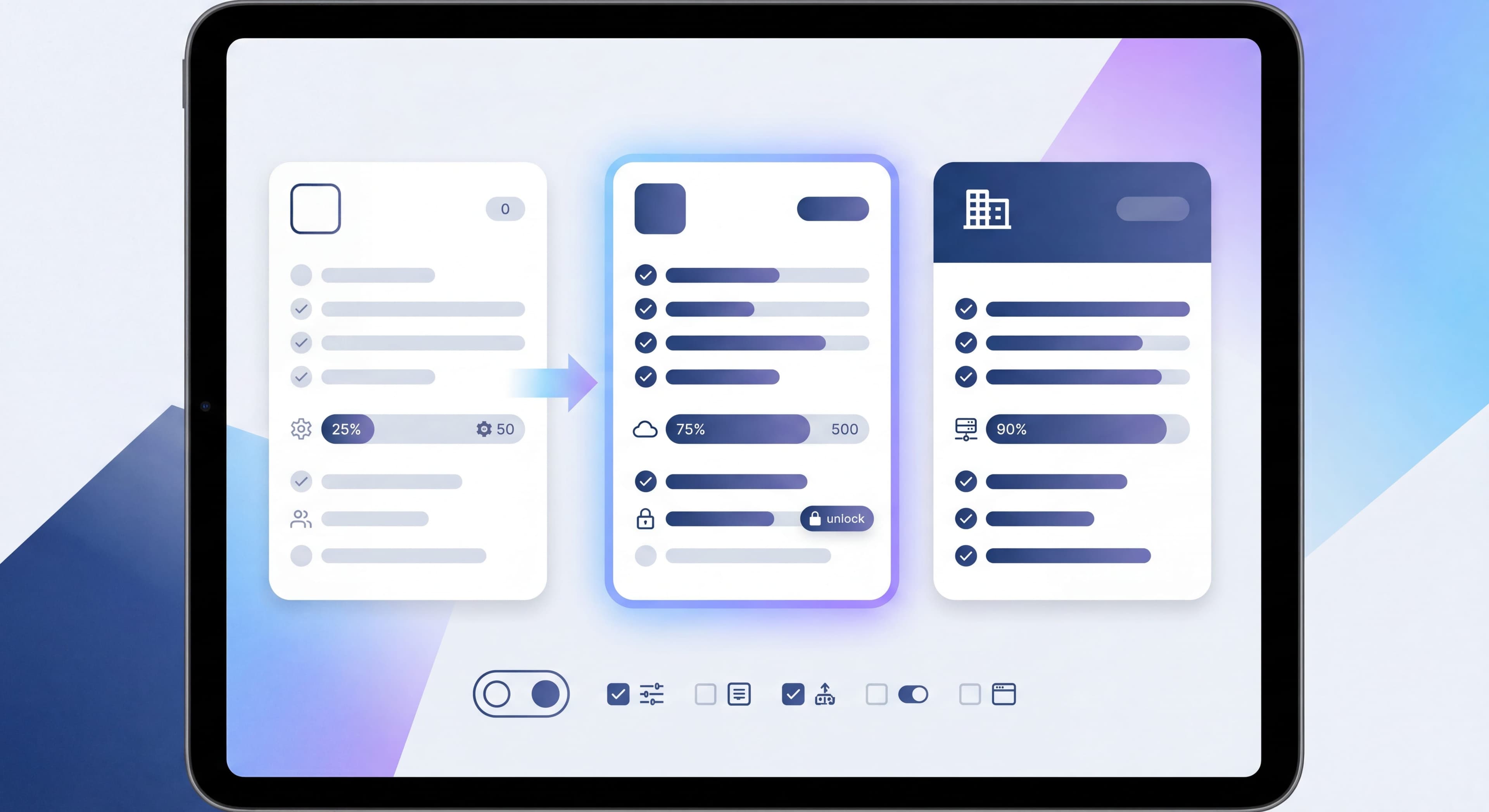

Freemium is powerful and misunderstood in equal measure. When it works, you get a massive top-of-funnel feeding continuous growth, viral loops where free users bring in more users, and qualified leads who've already experienced value. Slack, Dropbox, and Zoom prove what's possible with Slack exceeding 30% freemium conversion. When it fails, freemium becomes an expensive support burden that eats resources while barely generating revenue. The typical 2-5% conversion rate means 95-98% of users never pay anything, even as they consume infrastructure and support time.
This guide covers when freemium makes sense, how to design free tiers that deliver value while creating natural upgrade triggers, and how to avoid the traps that sink freemium businesses. Recent benchmarks show products with ACVs under $1K achieve median conversion rates around 10%, while products over $5K struggle to hit 5%. Understanding these dynamics helps you decide if freemium fits your model and how to execute it well.
Free users not upgrading?
Create step-by-step guides that showcase premium value and help users understand upgrade benefits with Glitter AI.
What is Freemium?
Freemium gives users a permanently free tier alongside paid plans. They can use the product forever without paying, but limitations encourage upgrading.
Freemium vs Free Trial
| Aspect | Freemium | Free Trial |
|---|---|---|
| Duration | Permanent | Time-limited |
| Functionality | Limited but useful | Usually full access |
| User Mindset | "This is free" | "I'm evaluating" |
| Conversion Rate | 2-5% | 15-25% |
| Volume Needed | High | Lower |
| Support Cost | Higher | Lower |
Freemium Conversion Benchmarks
Typical Freemium Conversion: 2-5%
This means 95-98% of users never pay. You need significant scale for freemium to work.
Comparison:
- Freemium to paid: 2-5%
- Free trial to paid: 15-25%
- Direct paid: Higher conversion, smaller funnel
When Freemium Works
Good Candidates for Freemium
Freemium isn't for everyone. It requires specific market conditions, product characteristics, and economics to work. You need honest assessment across several dimensions.
A large addressable market is non-negotiable. You need millions of potential users because with 2-5% conversion rates, meaningful revenue requires massive volume. If your TAM is in the thousands rather than millions, the math simply doesn't work. Freemium depends on scale to overcome low conversion rates, which makes it ideal for horizontal products with broad appeal but problematic for specialized verticals.
Low marginal cost per user matters equally. You'll serve far more free users than paid ones. If infrastructure, support, or operational costs per user are significant, free users become a drain rather than a growth investment. Freemium works great for software with negligible per-user costs (most SaaS, storage, communication tools) but fails for products with high compute costs, expensive integrations, or heavy human support needs.
Natural upgrade points need to exist where free tier limits become meaningful constraints users will pay to remove. These moments shouldn't feel arbitrary or punitive. They should represent genuine growth or evolving needs that make upgrades logical. Examples: hitting storage limits as data grows, needing team features as organizations scale, or requiring advanced capabilities as use cases mature. Without clear upgrade triggers, users stay free forever.
Network effects or viral mechanics multiply freemium's value by turning free users into acquisition channels. When free users invite teammates, share content, or create value for others who sign up, the cost of free users gets offset by the customers they recruit. This is why Slack, Zoom, and Calendly succeed with freemium. Every free user potentially brings in more. Without viral loops, you're relying purely on direct conversion, which makes economics harder.
Long sales cycles favor freemium by giving prospects extended evaluation without pressure. When buyers need weeks or months to assess fit, evaluate alternatives, and build internal consensus, freemium provides friction-free evaluation. Time-limited trials create artificial urgency that can backfire in complex B2B sales, while freemium accommodates longer decision timelines.
Successful Freemium Examples
Slack:
- Free: Unlimited users, limited history
- Upgrade trigger: Needing message history, integrations
- Virality: Teams invite colleagues
Dropbox:
- Free: Storage limit
- Upgrade trigger: Running out of space
- Virality: Referrals for more space
Calendly:
- Free: Basic scheduling
- Upgrade trigger: Team features, customization
- Virality: Every meeting is product exposure
Zoom:
- Free: 40-minute limit on group calls
- Upgrade trigger: Longer meetings
- Virality: Meeting invites
When Freemium Doesn't Work
Small Market:
Not enough volume to convert 2-5% into meaningful revenue.
High Support Needs:
Free users require expensive support.
No Natural Limits:
Hard to create upgrade triggers.
Enterprise-Only:
Business buyers don't want free, they want proven.
High Per-User Cost:
Infrastructure costs per user are significant.
Designing Your Freemium Tier
The Core Tradeoff
Too Generous:
Users never need to upgrade. No revenue.
Too Restrictive:
Users don't experience value. Don't stick around.
The Balance:
Enough value to stay, clear reasons to upgrade.
Limit Types
Feature Limits:
Premium features unavailable on free tier.
- Advanced analytics
- Custom branding
- Integrations
- Priority support
Usage Limits:
Quantity restrictions that grow with need.
- Storage space
- API calls
- Active projects
- Team members
Time Limits on Premium:
Access to premium features temporarily.
- Try premium free for X days
- Event-based access
Capability Limits:
Partial feature access.
- Basic reports (not advanced)
- Limited customization
- Fewer options
Choosing Limits
Effective Limits:
- Correlate with value received
- Grow with business need
- Easy to understand
- Natural upgrade triggers
Ineffective Limits:
- Arbitrary and annoying
- Don't correlate with value
- Punish core use cases
- Create workarounds
Example: Good vs Bad Limits
Good: "5 active projects" for project tool
- Scales with business need
- Natural upgrade when growing
Bad: "Can't export data" for project tool
- Punishes core functionality
- Creates resentment
- Users work around it
The "Aha Moment" Requirement
Free tier must include the aha moment.
If Users Can't Experience Value:
- They don't understand what they're missing
- They don't develop habits
- They leave before upgrading
The Free Tier Must:
- Deliver core value proposition
- Create the habit
- Then limit expansion
Conversion Optimization
Upgrade Triggers
Natural Moments:
- Hit usage limit
- Need premium feature
- Team grows
- Use case expands
Prompted Moments:
- Milestone reached (you're a power user!)
- Time-based (you've been with us X months)
- Event-based (annual planning season)
Upgrade UX
Make Upgrading Easy:
- Clear upgrade paths
- Simple pricing
- Self-serve purchase
- Minimal friction
Make Value Clear:
- Show what they'll get
- Quantify benefit if possible
- Social proof
Pricing Strategy
Anchoring:
Show free vs paid to demonstrate value gap.
Clear Tiers:
Don't overwhelm with options.
Entry Point:
First paid tier should be accessible.
Annual Discount:
Encourage commitment with savings.
Freemium Economics
The Math
Example:
- 100,000 free users
- 3% conversion rate
- $50/month ARPU
- Revenue: 3,000 × $50 = $150,000/month
Key Insight:
Small conversion rate changes have big impact at scale.
Cost Considerations
Free User Costs:
- Infrastructure
- Support
- Abuse prevention
- Opportunity cost
Must Be Lower Than:
Lifetime value of converted users + referral value of free users.
When Math Doesn't Work
Red Flags:
- Free user costs approaching paid revenue
- Support overwhelmed by free users
- No clear upgrade triggers
- Conversion rate declining
Freemium Onboarding
Free User Onboarding Goals
Primary:
Get users to aha moment quickly.
Secondary:
Create awareness of paid features.
Tertiary:
Identify high-potential upgraders.
Same questions over and over?
Create self-serve documentation that empowers users to help themselves with Glitter AI.
Onboarding Differences
Freemium Onboarding:
- No time pressure
- Focus on habit formation
- Gentle upgrade awareness
- Long-term nurturing
Trial Onboarding:
- Urgency built in
- Focus on evaluation completion
- Stronger conversion push
- Compressed timeline
Surfacing Premium Features
Tasteful Exposure:
- Show what's possible
- Don't block core experience
- Create desire, not frustration
Examples:
- "Pro tip: Premium users can also..."
- Advanced feature with "Premium" badge
- Brief feature discovery in onboarding
Product-Qualified Leads (PQLs)
Identifying Potential Upgraders
Not all free users are equal. Some are future paying customers.
PQL Signals:
- High engagement
- Approaching limits
- Team usage
- Premium feature interest
- Company characteristics
Prioritizing Conversion Efforts
Focus Sales/Success on:
- Users showing buying signals
- High-value accounts
- Engaged users near limits
Don't Waste Time On:
- Permanent free-riders
- Poor fit accounts
- Low engagement users
Common Freemium Mistakes
Mistake 1: Too Generous
Problem: Free tier has everything users need.
Result: No reason to upgrade.
Fix: Ensure clear value gap between tiers.
Mistake 2: Too Restrictive
Problem: Free tier doesn't deliver value.
Result: Users leave before experiencing product.
Fix: Ensure aha moment achievable on free tier.
Mistake 3: Ignoring Free Users
Problem: Treating free users as second-class.
Result: Bad word of mouth, missed conversions.
Fix: Invest in free user experience appropriately.
Mistake 4: Support Burden
Problem: Free users overwhelming support.
Result: Unprofitable model.
Fix: Self-serve support, community, smart deflection.
Mistake 5: No Upgrade Path Design
Problem: Hoping users will naturally upgrade.
Result: Lower conversion than possible.
Fix: Design deliberate upgrade triggers and paths.
Mistake 6: Wrong Market
Problem: Freemium in market that doesn't support it.
Result: Wasted resources, no scale.
Fix: Evaluate if freemium fits before committing.
Same questions over and over?
Create self-serve documentation that empowers users to help themselves with Glitter AI.
Freemium Alternatives
If Freemium Doesn't Fit
Reverse Trial:
Full access trial, then downgrade to free or convert.
Limited Free Trial:
Time-limited trial instead of permanent free.
Money-Back Guarantee:
Paid only, but easy refund.
Pilot Program:
Limited free use with commitment to evaluate.
Hybrid Approaches
Freemium + Trial:
Free tier exists, but premium trial also available.
Usage-Based Free:
Free up to usage threshold, then paid.
Developer/Startup Free:
Free for specific segments, paid for others.
Transitioning to Freemium
If Adding Freemium
Considerations:
- How will existing users react?
- Will it cannibalize paid?
- Do you have the infrastructure?
- Is the market large enough?
Approach:
- Test with segment first
- Monitor cannibalization
- Iterate before full rollout
If Removing Freemium
Considerations:
- Impact on brand
- Effect on virality
- User reaction
- Alternative model
Approach:
- Grandfather existing users if possible
- Communicate clearly
- Provide alternatives
Measuring Freemium Success
Key Metrics
Funnel Metrics:
- Free signups
- Free → Paid conversion rate
- Time to conversion
- Upgrade triggers hit
Economics Metrics:
- Cost per free user
- LTV of converted users
- Payback period
- Contribution margin
Growth Metrics:
- Viral coefficient
- Referral rate
- Organic growth
Healthy Freemium Indicators
- Conversion rate stable or improving
- Free user costs controlled
- Viral loops working
- Clear upgrade triggers
- Sustainable economics
Free users confused?
Create step-by-step guides that help free tier users experience your aha moment faster with Glitter AI.
The Bottom Line
Freemium can be a powerful growth engine, but only when the economics work, the market is big enough, and the free tier is designed thoughtfully. It's not a shortcut to growth. It's a specific strategy that works under specific conditions.
Key Principles:
- Ensure market is large enough
- Free tier must deliver aha moment
- Create natural upgrade triggers
- Control free user costs
- Design deliberate conversion paths
- Measure and optimize continuously
The best freemium products create genuine value for free users while making the path to paid feel like natural evolution, not escaping limitations.
Continue learning: Free Trial Best Practices and Upgrade Prompts.
Frequently Asked Questions
What is the difference between freemium and free trial?
Freemium offers a permanently free tier with limitations encouraging upgrades, with 2-5% typical conversion. Free trials provide time-limited full access with 15-25% conversion. Freemium requires high volume due to lower conversion but creates ongoing upgrade opportunities.
When does a freemium model work best for SaaS?
Freemium works best with a large market (millions of potential users), low marginal cost per user, natural upgrade points where limitations matter, network effects or virality where free users bring others, and long sales cycles requiring extended evaluation.
How do I set the right limits for a free tier?
Effective limits correlate with value received, grow with business needs, are easy to understand, and create natural upgrade triggers. The free tier must include your aha moment so users experience core value before hitting limitations. Avoid arbitrary limits that punish core use cases.
What is a typical freemium to paid conversion rate?
Typical freemium conversion is 2-5%, meaning 95-98% of users never pay. You need significant scale for freemium to work. In comparison, free trial conversion is 15-25% and direct paid has even higher conversion but a smaller funnel.
What are the biggest mistakes companies make with freemium?
Common mistakes include being too generous (no reason to upgrade), too restrictive (users leave before experiencing value), ignoring free users (bad word of mouth), letting support burden become unsustainable, and not designing deliberate upgrade paths and triggers.