Viral Loops: Building Referral Into Your Onboarding
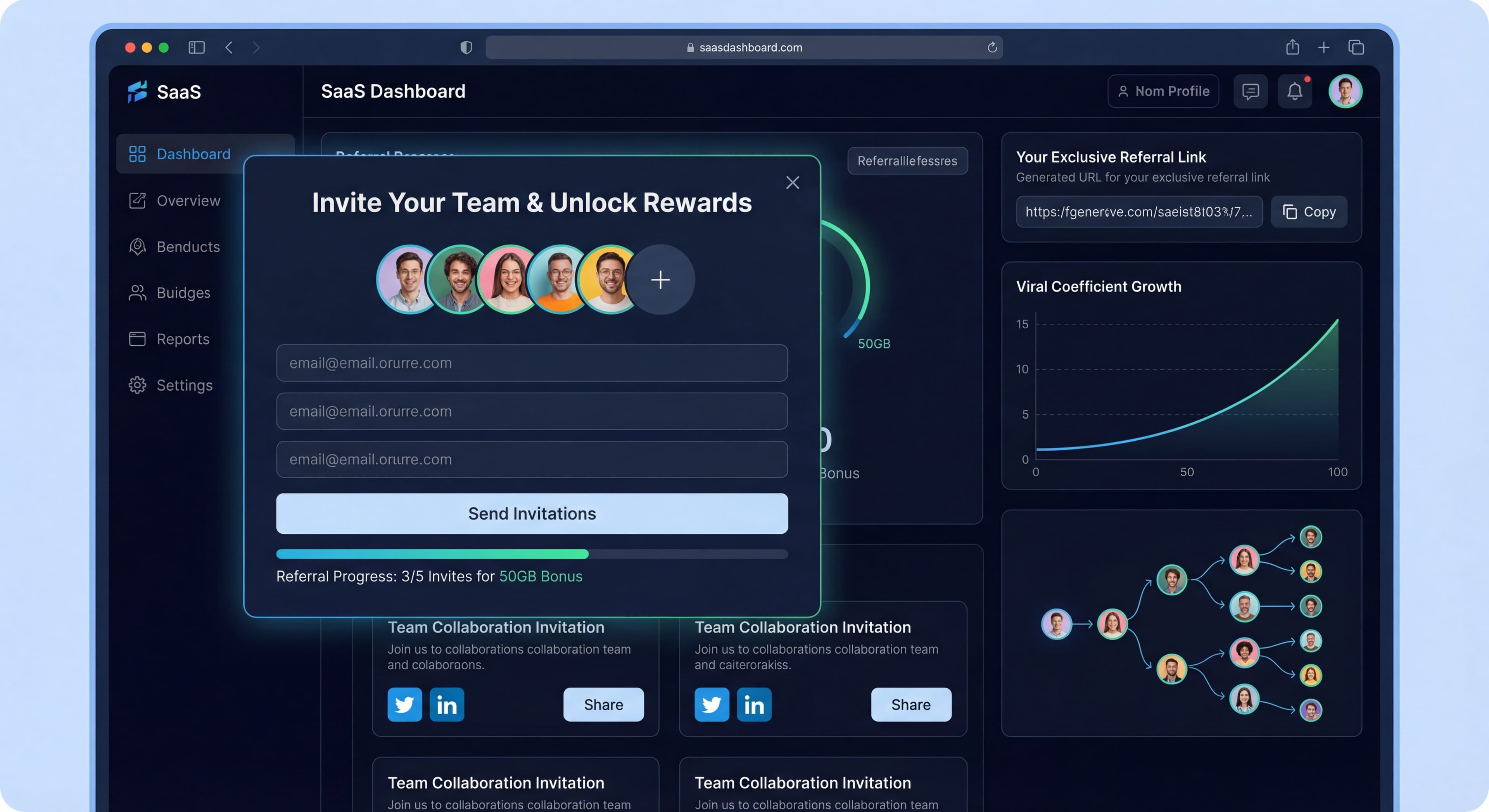

The best acquisition channel isn't paid ads, content marketing, or outbound sales. It's your existing users. When people naturally share your product through collaboration, output sharing, or direct referrals, your customer acquisition cost plummets. For each new customer acquired through viral channels, you're looking at near-zero marginal cost. Satisfied customers become an acquisition engine that grows without requiring proportionally larger marketing budgets. That's the kind of sustainable, capital-efficient growth every SaaS founder is chasing.
Onboarding is where viral loops SaaS companies want to activate. Users are at their most engaged, actively experiencing value, and most willing to take action. In those first few hours and days, they're exploring features, hitting their initial goals, and deciding whether your product actually solves their problem. That heightened engagement creates natural moments where sharing feels like an obvious next step rather than a weird marketing request. The question isn't whether to build viral mechanics into onboarding. It's how to do it in a way that feels natural and genuine instead of forced.
This guide covers how to design viral mechanics that turn onboarding into an acquisition engine, including different types of virality, where to integrate them, how to measure success, and examples from companies that have figured this out.
Onboarding taking too long?
Create step-by-step guides that get users to value faster and increase referral likelihood with Glitter AI.
Understanding Virality
What is a Viral Loop?
A viral loop is when product usage naturally leads to new user acquisition.
User A signs up → Uses product → Invites User B →
User B signs up → Uses product → Invites User C →
...and so on
Types of Virality
Each type of virality requires different design choices, technical work, and strategy. The best products often combine several viral mechanics so they reinforce each other.
Inherent Virality: This is the most powerful type because it's baked into the product itself. The product literally needs multiple users to work. Slack is the classic example: a team communication tool with one user is useless. It only becomes valuable when teammates join and conversations can happen. Zoom works the same way. You can't have a meeting alone, so every video call invitation is product exposure. Figma changed design collaboration by making real-time collaboration the default, not an add-on. Designers naturally invite stakeholders, developers, and other designers to view and comment. What makes inherent virality so effective is that it doesn't feel like marketing. Inviting others is just how you use the product.
Exposure Virality: This type uses your product's output or usage to expose non-users to the product where they can see it working. Calendly nailed this. Every scheduling link sent to a meeting participant shows off the Calendly brand and demonstrates how it kills back-and-forth email scheduling. DocuSign exposes thousands of document signers to the product through the signing experience, planting seeds for future adoption. Notion's template sharing and public pages mean valuable content naturally carries Notion branding. The power here is showing value rather than claiming it. People see the product working, which builds trust better than any ad.
Incentivized Virality: When your product doesn't have natural virality built in, you can create explicit rewards for sharing. Dropbox pioneered the dual-sided model where both referrer and new user get extra storage. It worked brilliantly because storage directly relates to the core product value, making the reward feel earned rather than random. Uber and Lyft built huge user bases with ride credits that lowered the barrier to trying the service while rewarding existing users. Cash bonuses are the most direct approach, but they risk attracting people who just want the reward rather than the product. The hard part is designing incentives that motivate real sharing without creating perverse incentives that lead to junk signups or fraud.
Word-of-Mouth: The purest virality happens when users are happy enough that they naturally recommend you to peers and colleagues without any prompting or incentives. This is harder to engineer because it depends on delivering genuine value and experiences that exceed expectations. But you can create conditions that make word-of-mouth more likely: focus on delight moments, solve painful problems really well, and make it easy for satisfied users to share. Products that save significant time, help users accomplish impressive results, or solve frustrating problems tend to generate strong word-of-mouth because users want to help others find solutions to shared challenges.
The K-Factor: Measuring Viral Growth
The K-factor (sometimes called viral coefficient) gives you a mathematical way to measure and improve viral growth. The formula is simple: K equals invitations sent per user multiplied by the conversion rate of those invitations. But actually improving K-factor requires thinking carefully about both parts of that equation and how they interact with your product economics and user behavior.
Here's a practical example: if your average user sends five invitations in their first thirty days, and 20% of those invitations become signups, your K-factor is 1.0 (5 x 0.2). That's a critical threshold where each user brings in exactly one new user, meaning your user base doubles with each viral cycle. How fast that doubling happens depends on viral cycle time, basically how long it takes for a new user to invite others and for those people to sign up.
K > 1 is true viral growth. Each user brings in more than one new user, creating exponential growth that can fuel explosive expansion. Products with K-factors above 1 can theoretically grow without additional marketing spend, though in practice maintaining K > 1 gets much harder as you move past early adopters into mainstream markets. Slack hit K-factors above 1 during early hyper-growth. Dropbox did too during the peak of their referral program.
K = 1 is steady-state. Your user base grows at a constant rate based on viral cycle time. Not exponential, but still powerful growth with no marginal acquisition cost. That said, market saturation, competition, and natural churn make maintaining K = 1 over long periods tough.
K < 1 is where most products sit most of the time, and that's completely fine. Even successful viral products usually operate here. The key insight is that even modest K-factors dramatically reduce customer acquisition costs. A K-factor of 0.3 means for every ten users you acquire through paid channels, you get three more through viral channels at essentially zero cost. Those three viral users bring in more users (0.3 x 3 = 0.9), who bring in more, creating a multiplier effect that significantly improves unit economics even without exponential growth.
Viral Coefficient Reality and Strategy
Here's the truth: most products run with K-factors well below 1, typically somewhere between 0.1 and 0.5 for products that have any viral mechanics at all. That doesn't mean your viral strategy failed. It means you should think about virality as a CAC reduction tool rather than a replacement for other acquisition channels. Even a K-factor of 0.2 means every five customers from paid marketing effectively become six when you account for viral propagation. That's a 16% reduction in effective CAC. Compounded over months and years, it adds up.
Onboarding as Viral Trigger
Why Onboarding Matters for Virality
High Engagement:
Users are actively using product.
Value Recognition:
Users just experienced benefit.
Natural Moment:
Setting up often involves others.
Prime Time:
Maximum enthusiasm for sharing.
Viral Opportunities in Onboarding
Team Invites:
Setting up a team product naturally involves inviting teammates.
Collaboration Setup:
Many products require others for core functionality.
Sharing Output:
First deliverable often shared with others.
Excitement Sharing:
New users most enthusiastic about discovery.
Designing Viral Mechanics
Built-In Collaboration
Design Principle:
Make the product more valuable with others.
Implementation:
- Core workflows involve collaboration
- Invite prompts at natural moments
- Easy invite process
- Value increases with team size
Example:
Project management tool where onboarding includes adding team members and assigning tasks.
Output Sharing
Design Principle:
Product output naturally reaches others.
Implementation:
- Easy sharing of created content
- Branding on shared output
- Clear call-to-action for recipients
- Frictionless signup for receivers
Example:
Calendly links expose Calendly to every meeting recipient.
Referral Programs
Design Principle:
Reward users for bringing others.
Implementation:
- Clear value exchange
- Easy sharing mechanism
- Tracking that works
- Prompt during onboarding
Example:
Dropbox: Invite friends, get more storage.
Integrating Virality Into Onboarding
Timing the Ask
Too Early:
User hasn't experienced value yet.
- Feels pushy
- Low conversion
- May create negative impression
Right Time:
After value demonstrated, when relevant.
- Natural moment
- User understands what they're recommending
- Higher conversion
Specific Moments:
- After first success
- When completing team setup
- After milestone achievement
- During natural sharing moments
The Invite Experience
Make It Easy:
- One-click invite
- Multiple methods (email, link, Slack)
- Bulk options
- Mobile-friendly
Show Value:
- Why invite others?
- What do recipients get?
- What does inviter get?
Reduce Friction:
- Pre-written messages
- Easy link copying
- Direct integration (Slack, email)
Invitation Copy
For Inviter:
Good: "Invite teammates to collaborate on this project"
Better: "Your team is building something great. Invite others to join."
Best: "Add [specific name from contacts] to this project"
For Recipient:
Good: "[Name] invited you to try [Product]"
Better: "[Name] invited you to collaborate on [Specific Project]"
Best: "[Name] needs your input on [Specific Task]"
Viral Loop Examples
Slack: Inherent Team Virality
Mechanic:
Slack is only useful with teammates.
Onboarding Integration:
- Workspace setup prompts team invites
- Easy bulk invite
- Email domain suggestions
- Value increases with team size
Result:
Every workspace created triggers multiple invites.
Dropbox: Incentivized Storage
Mechanic:
Invite friends, both get more storage.
Onboarding Integration:
- Referral option in getting started
- Clear value proposition
- Easy sharing tools
- Progress tracking
Result:
Users actively promoted to get more space.
Calendly: Output Exposure
Mechanic:
Every scheduled meeting exposes Calendly.
Onboarding Integration:
- Setup results in shareable link
- Recipients see Calendly branding
- Easy signup from scheduling page
- Natural use = natural exposure
Result:
Product spreads through professional networks.
Notion: Template Sharing
Mechanic:
Users share templates, exposing Notion.
Onboarding Integration:
- Easy template creation
- Public sharing options
- Template gallery discovery
- Community building
Result:
User-generated content drives discovery.
Measuring Viral Effectiveness
Processes undocumented?
Create step-by-step SOPs that capture best practices in minutes with Glitter AI.
Key Metrics
Invites Sent:
How many invitations per user during onboarding.
Invite Conversion Rate:
What percentage of invites become users.
K-Factor:
Invites × Conversion rate.
Viral Cycle Time:
How long from invite to the invitee inviting others.
Viral Coefficient by Source:
K-factor for different viral channels.
Tracking Implementation
What to Track:
- Invite events (sent, clicked, converted)
- Attribution (who invited whom)
- Time from invite to signup
- Viral user vs. organic user behavior
Analytics Setup:
Events to track:
- invite_sent (method, recipient_type)
- invite_clicked
- invite_signup
- referred_user_activated
Analysis Questions
Are users inviting?
What percentage send at least one invite?
Are invites converting?
What's the invite-to-signup rate?
Are viral users quality?
Do referred users activate and retain?
What channels work?
Email vs. link vs. in-app invite?
Optimizing Viral Loops
Increasing Invites
Make Inviting Easier:
- Fewer steps
- More methods
- Better timing
- Clear value
Create Reasons:
- Collaboration needs
- Social proof
- Incentives
- Natural moments
Improving Conversion
Better Recipient Experience:
- Clear context (why invited)
- Quick value preview
- Low-friction signup
- Immediate value
Social Proof:
- Who invited them
- What others accomplish
- Trust signals
Reducing Cycle Time
Faster Activation:
Viral users activate and invite faster.
Immediate Value:
Referred users see value immediately.
Prompt to Continue:
Once converted, prompt to continue the loop.
Processes undocumented?
Create step-by-step SOPs that capture best practices in minutes with Glitter AI.
Common Virality Mistakes
Mistake 1: Forcing Shares
Problem: Requiring sharing to proceed.
Result: Annoyed users, low-quality invites.
Fix: Make sharing optional but attractive.
Mistake 2: Wrong Timing
Problem: Asking for invites before value delivered.
Result: Users don't know what they're recommending.
Fix: Time invites to value moments.
Mistake 3: Friction for Recipients
Problem: Complicated signup for invited users.
Result: Low invite conversion.
Fix: Streamlined invited-user experience.
Mistake 4: No Tracking
Problem: Can't measure viral effectiveness.
Result: Can't optimize.
Fix: Proper attribution and analytics.
Mistake 5: Ignoring Quality
Problem: Optimizing for invites, not quality users.
Result: Many signups, few activations.
Fix: Track full funnel, optimize for activation.
Building Your Viral Strategy
Audit Current State
- What natural viral moments exist?
- What's current K-factor?
- Where do users share?
- What blocks inviting?
Design Improvements
- Identify best viral moments
- Design invite experience
- Create recipient experience
- Build tracking
Implement
- Build invite mechanics
- Integrate into onboarding
- Launch referral program if appropriate
- Deploy tracking
Optimize
- Measure viral metrics
- A/B test invite experiences
- Improve conversion
- Iterate continuously
When Virality Doesn't Fit
Not Everything Is Viral
Some products don't have natural viral mechanics:
- Solo-use tools
- Private/sensitive applications
- Enterprise (different dynamics)
- Specialized niches
Forced Virality Backfires
If your product isn't naturally viral:
- Don't force it
- Focus on other growth channels
- Virality isn't required for success
- Authenticity matters
Alternative Growth
- Content marketing
- Paid acquisition
- Partnerships
- Community building
Always explaining the same features?
Create step-by-step SOPs once and let users share them with their teams with Glitter AI.
The Bottom Line
Viral loops SaaS companies build work best when they feel natural and aligned with how users actually want to use your product. The best viral mechanics don't feel like marketing or growth hacks. They feel like features that make the product work better. Users invite teammates because they need collaboration to get things done, share outputs because they want feedback, and recommend products because those products genuinely helped them. When virality comes from real product value rather than artificial incentives, you get sustainable growth that compounds instead of spike-and-crash patterns.
The mental shift required here is moving from "how do we get users to invite others" to "how do we make our product more valuable when shared." That reframing changes how you design viral mechanics. Instead of interrupting flows with invite prompts, you find moments where inviting someone genuinely helps the user. Instead of generic referral rewards, you create incentives where the reward relates to core product value. Instead of pushing sharing before users understand your product, you time viral moments to when users have actually experienced value.
Key Principles for Sustainable Viral Growth:
-
Build virality into the product, not onto it. The best viral mechanics are intrinsic to how your product delivers value, not marketing tactics layered on top. Ask yourself whether your product genuinely becomes more valuable with more users, or whether you're trying to manufacture virality through incentives alone.
-
Time asks to value moments. Users who haven't experienced value can't advocate for your product because they don't know what they're recommending. Sequence viral prompts after users accomplish something meaningful, complete their first success, or hit an "aha moment."
-
Make sharing easy and valuable. Friction kills virality. Every extra step or form field reduces conversion. At the same time, make sure sharing provides clear value to both sides, not just abstract rewards but practical benefits like better collaboration or mutual access to useful features.
-
Optimize the full loop. Most teams focus only on increasing invites sent, but conversion rate and activation of invited users matter just as much. An invite that doesn't convert is worthless. A converted user who never activates won't continue the loop. Measure and optimize each stage.
-
Measure and iterate continuously. Viral mechanics rarely work perfectly the first time. Track invites sent, conversion rates, time to conversion, activation rates of viral vs organic users, and quality metrics. Run experiments on invite copy, timing, incentives, and recipient experience to improve K-factor over time.
The goal isn't forcing users to spread your product through aggressive prompts or overly generous rewards that attract the wrong people. The goal is making sharing the natural thing to do, the obvious next step that helps users accomplish their goals while introducing others to something genuinely useful. When user goals and viral mechanics align, growth becomes sustainable, users stay happy, and acquisition costs approach zero without sacrificing quality or retention.
Continue learning: Product-Led Growth Guide and Self-Serve Revenue.
Frequently Asked Questions
What is a viral loop in SaaS?
A viral loop is when product usage naturally leads to new user acquisition through a cycle where users sign up, experience value, invite others, and those invitees repeat the process, creating self-sustaining growth.
What is K-factor and why does it matter for SaaS growth?
K-factor measures viral growth by multiplying invitations sent by conversion rate. A K-factor above 1 means each user brings more than one new user, creating exponential growth. Even a K-factor of 0.3 adds 30% more users through viral channels alone.
When is the best time to ask users for referrals during onboarding?
The best time to ask for referrals is after users have experienced value, such as after their first success, when completing team setup, after milestone achievements, or during natural sharing moments when they understand what they're recommending.
What are the different types of product virality?
The four main types are inherent virality (products requiring multiple users like Slack), exposure virality (usage exposes others like Calendly links), incentivized virality (rewards for referrals like Dropbox's storage bonus), and word-of-mouth from satisfied users.
How can SaaS companies build viral mechanics into their referral program?
Build virality into your product by making it more valuable with collaboration, enabling easy output sharing with branding, creating clear referral incentives, reducing friction in the invite process, and timing referral prompts to value moments during onboarding.