Product-Led Growth: The Complete Guide for Product Managers
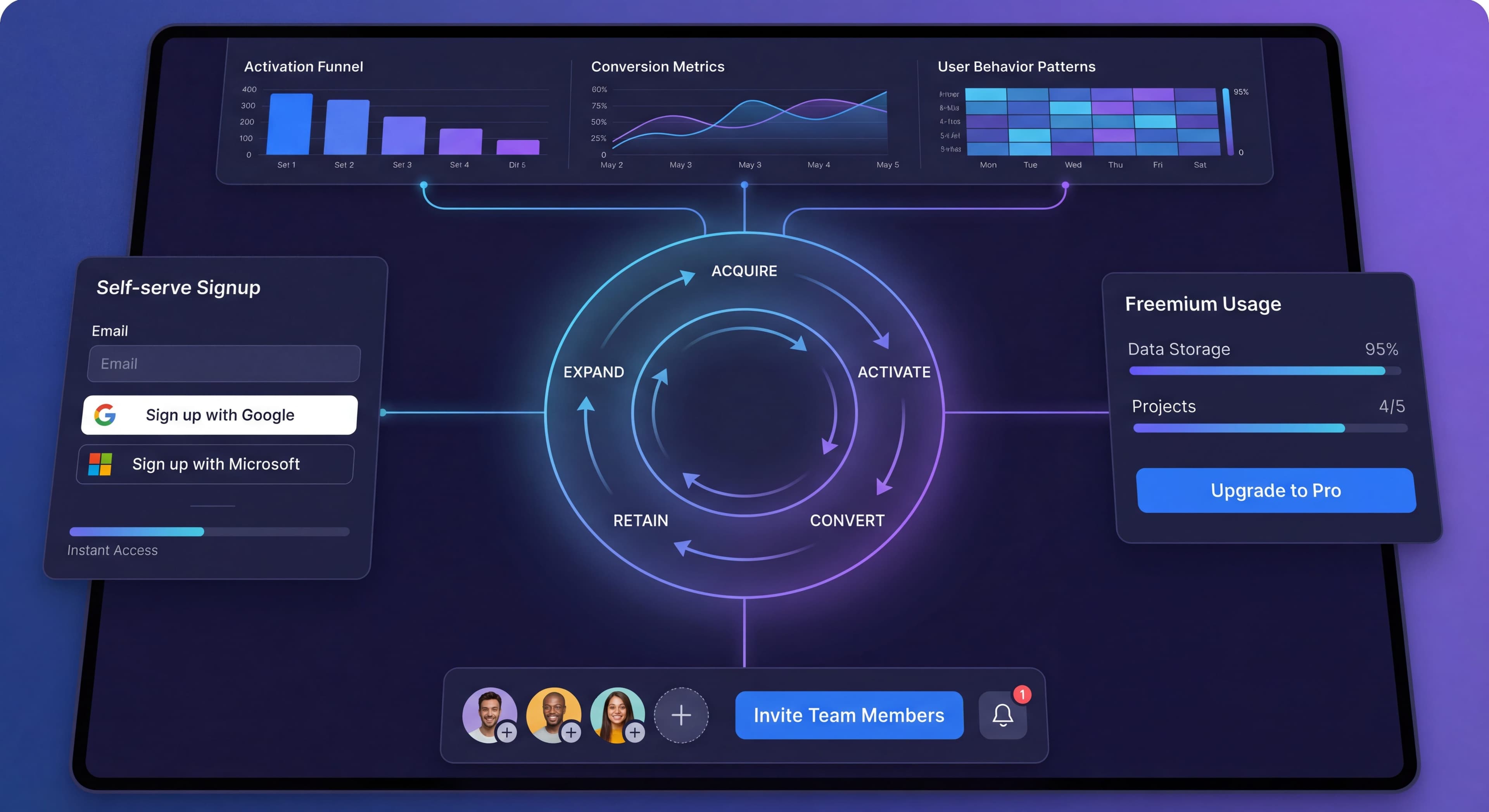

Product-led growth has changed how successful SaaS companies bring in customers and keep them. Instead of leaning heavily on sales and marketing, PLG companies let the product do the heavy lifting. Users experience value first, then decide whether to pay.
This guide walks through what product managers need to know to build and optimize PLG strategies.
Activation taking too long?
Create step-by-step guides that help users reach value faster and drive PLG conversion with Glitter AI.
What is Product-Led Growth?
Product-led growth is an approach where the product itself drives acquisition, expansion, conversion, and retention.
Core Principle: Users experience meaningful value before they make any purchasing decision.
PLG Characteristics
- Self-serve signup and onboarding
- Free trial or freemium model
- Product experience drives conversion
- Viral mechanics built into how the product works
- Decisions based on data
- Low-friction expansion
The PLG Motion
- Acquire: Users find and sign up on their own
- Activate: Users experience core value quickly
- Convert: Demonstrated value leads to paid conversion
- Retain: Continued value builds loyalty
- Expand: Success drives upgrades and referrals
PLG vs Sales-Led Growth
Sales-Led Growth (Traditional)
- Sales team drives acquisition
- Demo/evaluation before access
- Contract negotiation
- High touch throughout
- Revenue follows relationship
When Sales-Led Works:
- Complex enterprise products
- High ACV deals ($50K+)
- Long implementation cycles
- Buying committees
Product-Led Growth
- Product drives acquisition
- Self-serve access immediately
- Value before purchase
- Low touch, high automation
- Revenue follows experience
When PLG Works:
- Products with quick time-to-value
- Broad potential user base
- Lower price points (or freemium)
- Individual or team adoption
Hybrid Approaches
Many successful companies combine both:
- PLG for acquisition and qualification
- Sales for expansion and enterprise deals
- Product Qualified Leads (PQLs) bridge the gap
PLG Principles
Getting PLG principles right changes how products grow, shifting from expensive sales-driven acquisition to more efficient product-driven expansion. Companies using product-led growth strategies see up to 2x faster revenue growth compared to sales-led competitors, according to 2025 industry research. These principles work together. Each one reinforces the others, creating a compounding growth engine that gets more powerful over time.
1. Design for Self-Service
Product-led growth depends on users being able to discover, try, and adopt your product on their own, without sales calls, implementation consultants, or hand-holding. This self-service approach democratizes access while slashing customer acquisition costs. It enables scalable growth that sales-led models simply can't match. Every friction point you remove expands your addressable market by making the product accessible to users who would never engage with traditional sales.
Frictionless signup is the first requirement. Remove every obstacle between interest and product access. Today's SaaS buyers expect instant gratification. They want to start using products within minutes of discovering them, not days or weeks later. Intuitive onboarding guides new users to value without requiring tutorials, documentation, or support tickets. It respects their time while cutting your support costs. Self-serve help and automated guidance let users find answers and get unstuck on their own, keeping momentum toward activation instead of getting stuck waiting for human help that might come too late.
2. Deliver Value Before Payment
Product-led growth economics depend on proving value before asking for money, which flips the traditional model where companies sell promises and deliver value later. This value-first approach reduces buyer risk while building trust that makes conversion feel natural, not forced. The tricky part is calibrating exactly how much to give away for free. Too little and you fail to show what your product can do. Too much and nobody has a reason to upgrade.
Finding the right balance takes real understanding of your value proposition and how users think. Provide enough functionality that users experience genuine "aha moments" and see concrete evidence of how your product improves their work. But reserve enough advanced capabilities, scale, or convenience that successful free users eventually hit limitations that upgrading would solve. The best PLG companies design upgrade paths that feel like natural progressions rather than arbitrary gates. Paid tiers should feel like unlocking even more value, not removing annoying restrictions.
3. Build in Virality
When using your product naturally creates awareness among non-users, you get organic growth that compounds over time without spending proportionally more on marketing. Designed thoughtfully, this viral mechanism turns every user into a potential acquisition channel. The most powerful viral products make sharing or collaboration so central to their value that users invite others not as a favor to you, but to make their own experience better.
Collaboration features that require inviting teammates create loops where each new user brings more potential users. Sharing capabilities let users distribute their work to people who see real-world applications rather than marketing messages. Products with visible output, like Calendly's scheduling pages or Figma's shared designs, turn every use into a subtle advertisement. Network effects make products more valuable as more people use them, creating strong retention while simultaneously driving acquisition through word-of-mouth.
4. Optimize for Conversion Through Product
In product-led growth, the product experience drives conversion, not sales pressure or marketing persuasion. Users upgrade because they've hit limitations, discovered they need advanced features, grown their team, or accumulated enough value that paying feels logical rather than reluctant. This organic approach to conversion leads to higher satisfaction and lower churn than high-pressure tactics because users choose paid tiers when they're genuinely ready and convinced of value.
Good conversion design identifies moments when free users naturally want to upgrade and makes that transition easy. Usage limits that free users hit after experiencing success create clear triggers. They're not abandoning your product; they're succeeding enough to outgrow the free tier. Advanced feature needs emerge as users get more sophisticated and ambitious, naturally progressing toward capabilities worth paying for. Team growth forces decisions about collaboration that free tiers often deliberately constrain. Throughout this journey, demonstrated value builds conviction that makes the payment decision straightforward.
5. Use Data to Drive Decisions
Product analytics are the nervous system of successful PLG companies, informing decisions from feature development to pricing. Sales-led companies rely on CRM data and sales feedback. Product-led companies instrument their products thoroughly to understand exactly how users behave, what drives activation and retention, and which features create the most value. This approach eliminates guesswork and politics, replacing opinions with evidence about what actually works.
User behavior patterns show how successful users differ from those who churn, letting you optimize onboarding to replicate success patterns. Conversion correlations reveal which actions or usage levels predict upgrade probability, so you can encourage those specific behaviors. Feature adoption data shows which capabilities drive value versus which just clutter the interface, informing both product development priorities and pricing decisions. Churn predictors enable proactive retention efforts while revealing which value propositions actually matter versus those that sound good in marketing but don't drive real engagement.
Building for PLG
Signup and Onboarding
PLG Signup Requirements:
- Minimal fields (email often sufficient)
- Social login options
- No credit card for trial
- Immediate product access
PLG Onboarding:
- Self-serve completely
- Quick time-to-value
- Progressive disclosure
- Automated guidance
Free/Freemium Tier Design
Questions to Answer:
- What's enough to demonstrate value?
- What features drive upgrades?
- How do we prevent permanent free users?
- What limits are fair and functional?
Limit Types:
- Feature limits (premium features gated)
- Usage limits (X records, Y actions)
- Seat limits (limited team size)
- Time limits (trial period)
Conversion Points
Natural Upgrade Moments:
- Hit usage limit
- Need restricted feature
- Add team members
- Reach success milestone
Conversion UX:
- Clear upgrade path
- Value-based messaging
- Self-serve payment
- Minimal friction
Expansion Mechanics
Expansion Opportunities:
- Seat additions
- Tier upgrades
- Add-on features
- Usage overages
Expansion Triggers:
- Team growth
- Success with current tier
- Advanced needs emerge
- Usage increases
PLG Metrics That Matter
Acquisition Metrics
Signups: Volume and quality of new registrations
Acquisition Source: Where users come from
Signup Conversion: Visitor → Signup rate
Activation Metrics
Activation Rate: % reaching activation threshold
Time to Value: How quickly users experience value
Onboarding Completion: % completing onboarding
Conversion Metrics
Free to Paid Conversion: % of free users who convert
Trial Conversion: % of trial users who pay
Time to Conversion: How long conversion takes
Revenue Metrics
ARPU: Average Revenue Per User
LTV: Lifetime Value
Net Revenue Retention: Revenue from existing customers over time
Efficiency Metrics
CAC Payback: Time to recover acquisition cost
LTV:CAC Ratio: Should be >3:1 for healthy PLG
Common PLG Challenges
Product-led growth promises efficient, scalable acquisition, but making it work requires navigating challenges that can trip up even well-intentioned teams. Knowing these common obstacles and their solutions helps you avoid costly mistakes while building a sustainable PLG engine. Each challenge involves competing priorities that need thoughtful balance rather than simple fixes.
Challenge 1: Balancing Free Value
The core tension in PLG is giving away enough free value to attract and activate users while keeping enough back to motivate upgrades. Give too much and nobody has a reason to pay. Give too little and users never experience enough to develop conviction about your product, abandoning before they understand what they're missing. Finding the "just right" amount takes continuous experimentation.
Testing different limit configurations shows which constraints motivate upgrades without frustrating free users too early. Some companies limit features, saving advanced capabilities for paid tiers. Others limit usage through record counts, API calls, or monthly actions. Some constrain team size or collaboration. The right approach depends entirely on your value proposition and how users actually behave. Analyzing conversion patterns by free usage level identifies the sweet spot where users have experienced enough value to appreciate your product while hitting limitations that upgrading would solve. Cohort analysis reveals which features drive upgrades. If users who try a particular capability convert at 3x the rate of those who don't, that feature becomes a candidate for paid tiers.
Knowledge stuck in silos?
Create step-by-step guides that share expertise across your entire team with Glitter AI.
Challenge 2: Supporting at Scale
Traditional support models break down when you have thousands of free users expecting help but generating no direct revenue. The economics don't work. You can't provide human support to every free user without burning through cash unsustainably. But ignoring support requests creates bad experiences that hurt your reputation and prevent the activation that drives conversion. Solving this means rethinking support entirely, from a cost center to a strategic investment in activation.
Strong self-serve resources transform support from human-intensive to scalable by letting users solve their own problems. Good documentation, video tutorials, and interactive guides handle common questions without support tickets. Community forums let your user base provide peer-to-peer help, often delivering faster and more practical answers than official channels. AI-assisted support triages inquiries, answers common questions automatically, and routes complex issues to humans when needed, dramatically improving efficiency. Reserving human support for paid customers can motivate upgrades while keeping support loads manageable, though this requires excellent self-serve resources so free users don't get unnecessarily frustrated.
Challenge 3: Enterprise Compatibility
Large organizations have requirements that pure product-led models struggle with: security certifications, compliance frameworks, procurement processes, and buying committees. These enterprise realities clash with PLG's emphasis on individuals adopting products and upgrading with credit cards. Companies that ignore enterprise needs leave money on the table. Those that compromise PLG principles to chase enterprise deals often undermine the efficiency that made PLG attractive in the first place.
Hybrid approaches maintain PLG for initial adoption while layering in sales assistance for enterprise deals. Individual users can still discover, try, and adopt your product the product-led way, but when usage spreads across organizations and reaches enterprise scale, sales teams step in for security reviews, contract negotiations, and organizational rollout. Self-serve with sales assist creates smooth transitions rather than forcing a choice between PLG and traditional sales. Enterprise tiers with appropriate features like SSO, advanced security, admin controls, and SLAs acknowledge enterprise requirements without compromising the experience for individual users and small teams.
Challenge 4: Long Sales Cycles for Upgrades
Individual users often fall in love with products but struggle to get organizational approval for paid subscriptions, especially when pricing hits hundreds or thousands of dollars monthly. These enthusiastic users get stuck between wanting to upgrade and organizational friction: budget approvals, competing priorities, risk-averse IT. Without help, many of these potential conversions stall indefinitely despite genuine intent to purchase.
Building bottom-up adoption features that spread products virally within organizations turns individual enthusiasm into organizational momentum. When a product delivers collaboration value, individual users naturally invite teammates, creating organic expansion that eventually hits critical mass where organizational adoption feels inevitable. Social proof within organizations, like usage stats showing "47 people at your company use this product," creates FOMO and validation that helps advocates make the case for broader adoption. Product-Qualified Account identification recognizes when enough individuals at one organization have adopted to warrant sales engagement, letting you target sales assist exactly when it can push stalled deals across the finish line.
Challenge 5: Measuring Attribution
Product-led journeys touch multiple channels: marketing, product usage, organic discovery. Traditional attribution models can't capture this accurately. A user might discover your product through content marketing, sign up after a webinar, activate through in-app guidance, and convert after using a specific feature. Which touchpoint deserves credit? The complex, non-linear paths PLG encourages make simple first-touch or last-touch attribution misleading.
Integrating product analytics creates a complete view of user journeys that includes both marketing touchpoints and in-product behavior. Rather than relying on just marketing automation data or just product data, successful PLG companies unify these streams to see full paths from awareness to conversion. Multi-touch attribution models assigning fractional credit across touchpoints offer more nuance than single-touch approaches, though they add complexity. Often, focusing on leading indicators like activation rates, engagement levels, and feature adoption proves more actionable than chasing perfect attribution. Improving these metrics reliably drives downstream conversion regardless of which touchpoint technically gets credit.
PLG Case Studies
Slack: Viral Team Adoption
PLG Mechanics:
- Free tier with generous limits
- Invites create viral spread
- Value increases with team adoption
- Natural upgrade triggers (history, integrations)
Key Metric: 2,000 messages as activation threshold
Dropbox: Referral Growth
PLG Mechanics:
- Free storage tier
- Referral program for more space
- Syncing creates awareness
- Team features drive enterprise adoption
Key Metric: File on multiple devices as aha moment
Calendly: Output Virality
PLG Mechanics:
- Free individual scheduling
- Recipients see Calendly branding
- Each use is a product advertisement
- Team features for professional use
Key Metric: Each scheduled meeting = new impression
Notion: Template Virality
PLG Mechanics:
- Powerful free tier
- Shareable templates spread product
- Team workspace collaboration
- Clear path to team/enterprise plans
Key Metric: Template shares and imports
Implementing PLG
Phase 1: Foundation (Month 1-2)
Product Requirements:
- Self-serve signup complete
- Free tier/trial defined
- Basic onboarding automated
- Analytics instrumented
Goal: Users can sign up and experience value independently.
Phase 2: Optimization (Month 2-4)
Focus Areas:
- Activation rate improvement
- Time to value reduction
- Conversion point optimization
- Basic viral mechanics
Goal: Improving activation and conversion metrics.
Phase 3: Scale (Month 4-6)
Focus Areas:
- Referral/viral programs
- Expansion mechanics
- PQL process
- Support scaling
Goal: Growth engine running efficiently.
Phase 4: Mature (Month 6+)
Focus Areas:
- Sophisticated segmentation
- Advanced analytics
- Predictive models
- Continuous optimization
Goal: Predictable, efficient growth machine.
Knowledge stuck in silos?
Create step-by-step guides that share expertise across your entire team with Glitter AI.
PLG Team Structure
Product Team Role
- Own onboarding experience
- Drive activation metrics
- Design conversion paths
- Build viral mechanics
Growth Team Role
- Optimize acquisition
- Test conversion experiments
- Analyze and segment users
- Scale what works
Success Team Role
- Support PQLs
- Enable expansion
- Handle enterprise needs
- Inform product improvements
Marketing Team Role
- Drive awareness
- Create self-serve content
- Support product-led content
- Measure attribution
PLG Tech Stack
Essential Tools
Product Analytics:
Amplitude, Mixpanel, or Heap for user behavior
Customer Data Platform:
Segment for data integration
Onboarding Platform:
Appcues, Userpilot, or similar for guidance
Email Automation:
Customer.io or Intercom for lifecycle messaging
Billing:
Stripe for self-serve payments
Measurement Requirements
- Event tracking for all key actions
- Cohort analysis capability
- Funnel visualization
- Segment comparison
Is PLG Right for You?
PLG Fit Assessment
Strong PLG Fit:
- Product can deliver value quickly
- Large addressable market
- Individual or team can adopt
- Clear path to monetization
Weak PLG Fit:
- Complex implementation required
- Small market, high-touch needed
- Can't demonstrate value without data
- Enterprise-only product
Transition to PLG
If moving from sales-led to PLG:
- Start with experiment: PLG for segment, not company-wide
- Preserve what works: Sales-led for enterprise
- Build capability: Team, tools, culture
- Iterate: Learn and adjust approach
Onboarding still manual?
Build SOPs that scale self-serve onboarding without adding headcount with Glitter AI.
The Bottom Line
PLG isn't just a go-to-market strategy. It's a company-wide philosophy that puts product experience at the center of growth. Done well, it creates compounding returns: better products attract more users who convert more efficiently.
The key is aligning product development, onboarding, and monetization around helping users succeed. When users win quickly, businesses win sustainably.
Continue learning: Free Trial Best Practices and Product Qualified Leads.
Frequently Asked Questions
What is product-led growth (PLG)?
Product-led growth is a business methodology where user acquisition, conversion, expansion, and retention are driven primarily by the product itself. Users experience meaningful value through self-serve signup and free trials before making any purchasing decision.
When should a SaaS company use product-led growth vs sales-led growth?
PLG works best for products with quick time-to-value, broad user bases, and lower price points where individuals or teams can adopt. Sales-led growth is better for complex enterprise products with high ACV deals ($50K+), long implementation cycles, and buying committees.
What is the PLG motion and how does it work?
The PLG motion follows five stages: Acquire (users sign up independently), Activate (users experience core value quickly), Convert (value demonstrated leads to payment), Retain (continued value creates loyalty), and Expand (success drives upgrades and referrals).
What are the most important metrics for product-led growth?
Key PLG metrics include activation rate, time to value, free-to-paid conversion rate, trial conversion rate, ARPU (Average Revenue Per User), LTV (Lifetime Value), Net Revenue Retention, CAC payback period, and LTV:CAC ratio (should be greater than 3:1).
How do you balance free value in a freemium or free trial model?
Offer enough free value to demonstrate the product's potential but not so much that users never need to upgrade. Test different limit configurations (feature limits, usage limits, seat limits, time limits), analyze conversion by usage patterns, and identify features that drive upgrades.