Self-Serve vs High-Touch Onboarding: Which is Right for Your Product?
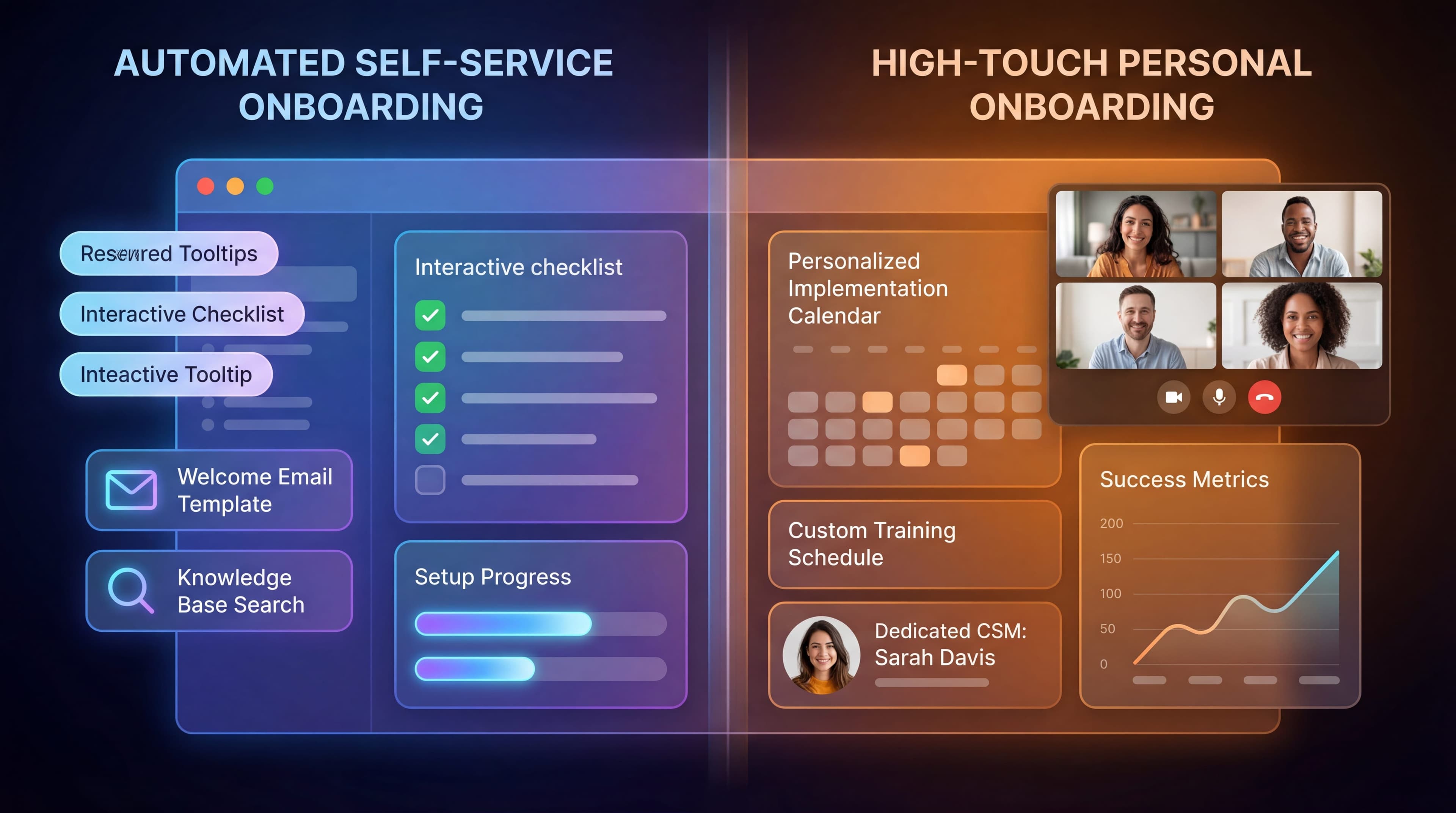

Self-serve versus high-touch onboarding isn't a binary choice. It's a spectrum. Where your product lands on that spectrum, and how well you optimize for it, directly affects activation rates, CAC efficiency, and how well you can scale. Self-serve onboarding has evolved a lot. It's moved from basic checklists to adaptive, personalized journeys that can match human-assisted approaches in effectiveness. When onboarding is structured well, it can improve retention by 82% and get users to full productivity 34% faster.
Self-serve isn't just for SMBs and low-touch accounts anymore. It's become essential across every segment, even for enterprise customers who also get high-touch support. Most onboarding experiences now blend high-touch and low-touch. Customers want to self-service when they can, but they also want to know human help is there for complex problems. The companies doing this well use data to figure out exactly when and where human intervention actually adds value.
This guide provides a framework for making this decision.
Users waiting for calls?
Create step-by-step guides that let users onboard themselves instantly with Glitter AI.
Defining the Spectrum
Self-Serve Onboarding
Users onboard themselves through in-app guidance, documentation, and automated communication. No human intervention required.
Characteristics:
- In-app tours, tooltips, checklists
- Automated email sequences
- Knowledge base and help documentation
- Community support
- Zero or minimal human contact
Best for:
- High volume, lower ACV products
- Simple-to-understand products
- Product-led growth companies
- Tech-savvy user bases
High-Touch Onboarding
Users receive personalized guidance from humans—typically customer success, onboarding specialists, or account managers.
Characteristics:
- Dedicated onboarding calls
- Personalized implementation support
- Custom training sessions
- Hands-on configuration help
- Ongoing human relationship
Best for:
- Low volume, high ACV products
- Complex products requiring configuration
- Enterprise customers with specific needs
- Regulated industries requiring compliance
Hybrid Approaches
Most products fall somewhere in between, combining self-serve elements with human touchpoints at key moments.
Examples:
- Self-serve with optional expert calls
- Automated onboarding with CSM check-in
- Self-setup with implementation support
- Tiered by customer value/plan
When to Use Each Approach
Choosing between self-serve and high-touch means weighing multiple factors at once. Product complexity, customer expectations, price point, user sophistication, segment needs. They all interact. Getting this right helps you avoid over-investing in high-touch for customers who want autonomy, or under-investing in support for customers who genuinely need help.
Self-Serve Makes Sense When:
Product intuitiveness is the foundation. Users need to understand core value without anyone explaining it. Maybe your product is simple, or maybe you've invested heavily in UX. Self-serve works when users can achieve their first meaningful outcome within minutes, without scheduling calls or watching long training videos. Slack, Notion, and Figma work this way. Core value is immediately apparent. Users create value in their first session.
Customer volume makes self-serve not just preferable but necessary. With thousands of monthly signups, human touch for everyone becomes impossible. Do the math: 30-minute onboarding calls times 10,000 signups equals 5,000 hours. That's 58 full-time employees doing nothing but onboarding. Self-serve is the only viable path at high volume.
ACV constraints set hard economic limits. Products priced $0-$1,000 per year can't afford dedicated onboarding resources when you need to recover CAC within 6-12 months. A customer paying $50/month generates $600 annually. Spending hours of human time on their onboarding destroys unit economics. Most consumer SaaS and lower-tier B2B defaults to self-serve because the economics demand it.
User technical sophistication matters. Developers, designers, tech professionals can figure things out. More than that, they prefer to. They find hand-holding patronizing and sales calls interruptive. They want docs, API references, freedom to explore. Forcing high-touch on technical users can actually hurt activation.
Speed requirements have changed. Users expect value now, not after scheduling a kickoff call next week. When users are evaluating you against competitors, they want instant trial access. If your competitor offers that and you require a call, you've probably lost before you started. Self-serve removes time-based friction entirely.
High-Touch Makes Sense When:
Product is complex
Enterprise software, platforms with significant configuration, or products requiring implementation.
ACV is high
$10,000+/year customers justify dedicated resources.
Implementation is required
Data migration, integration setup, or workflow configuration.
Stakeholders need alignment
Multiple decision-makers who need education and buy-in.
Industry requires it
Regulated industries, compliance needs, or risk management concerns.
Churn cost is high
Losing an enterprise customer is catastrophic.
Hybrid Makes Sense When:
You serve multiple segments
SMB and enterprise need different approaches.
Product has a learning curve
Self-serve gets users started, human help scales them.
Specific milestones benefit from touch
Automated until a critical moment, then human intervention.
You're transitioning
Moving from high-touch to more scalable model.
Building Self-Serve Onboarding
Core Components
In-App Guidance
- Product tours for first-run experience
- Contextual tooltips at relevant moments
- Checklists driving key actions
- Empty state guidance
Automated Communication
- Welcome email sequence
- Behavioral triggers based on actions (or inaction)
- Milestone celebrations
- Re-engagement for inactive users
Self-Service Resources
- Knowledge base with searchable articles
- Video tutorials for visual learners
- In-app resource center
- Community forums
Intelligent Defaults
- Smart setup that minimizes configuration
- Pre-populated templates and examples
- Sensible default settings
Self-Serve Best Practices
Measure Everything
Track every step, identify drop-off, optimize continuously.
Segment Experiences
Different users need different paths. Personalize based on role, use case, or behavior.
Provide Escape Hatches
Even in self-serve, users should be able to reach humans when truly stuck.
Iterate Aggressively
Self-serve enables rapid experimentation. A/B test continuously.
Building High-Touch Onboarding
Core Components
Onboarding Calls
Structured sessions with clear agendas, outcomes, and follow-ups.
Implementation Support
Hands-on help with setup, configuration, and data migration.
Training Programs
Role-specific training for different user types within the organization.
Ongoing Relationship
Regular check-ins during the critical first 90 days.
High-Touch Best Practices
Standardize the Process
Create playbooks for consistency. Document what works.
Set Clear Expectations
What will happen when. What's required from the customer.
Define Success Metrics
What does successful onboarding look like? When is it "complete"?
Document and Hand Off
Clean transition from onboarding to ongoing customer success.
High-Touch Team Structure
Onboarding Specialists
Dedicated to implementation. Hand off to CS after success.
Customer Success Managers
Own ongoing relationship. May do onboarding for key accounts.
Solutions Engineers
Technical implementation support for complex integrations.
Training Team
Scalable training delivery for larger customer bases.
Hybrid Approaches
Model 1: Tier-Based
- Free/Low tier: Fully self-serve
- Mid tier: Self-serve with email support
- Enterprise: Dedicated onboarding
Model 2: Milestone-Based
- Setup: Self-serve with documentation
- First value: Automated celebration and guidance
- Week 2: CSM check-in call
- Month 1: Success review
Model 3: Intent-Based
- Users self-serve by default
- "Request a call" option available
- Triggered outreach for high-value prospects
- CSM involvement for at-risk accounts
Model 4: Complexity-Based
- Simple use cases: Self-serve
- Integration required: Implementation support
- Team rollout: Training program
- Enterprise customization: Solutions engineering
Resource Requirements
Same questions over and over?
Create self-serve documentation that empowers users to help themselves with Glitter AI.
Self-Serve Resources
Technology:
- Digital adoption platform (Appcues, UserGuiding, etc.)
- Email automation (Customer.io, Intercom, etc.)
- Knowledge base (Help Scout, Notion, etc.)
- Analytics (Mixpanel, Amplitude, etc.)
Team (Ongoing):
- Product manager/owner for onboarding
- Content creator for documentation
- Designer for in-app experiences
- Analyst for optimization
Investment:
- $500-5,000/month in tools
- 0.5-2 FTE for optimization
High-Touch Resources
Team:
- Onboarding specialists (1 per X customers)
- CSMs for relationship ownership
- Implementation/solutions engineers (optional)
Technology:
- CRM (Salesforce, HubSpot)
- CS platform (Gainsight, ChurnZero)
- Meeting/training tools (Zoom, Loom)
Investment:
- $60-150K/year per onboarding specialist
- Ratio of 1:20-1:50 active implementations
Hybrid Resources
Combines elements of both, typically:
- Self-serve foundation
- Targeted human intervention
- Clear handoff points
- Flexible resource allocation
Making the Transition
Moving from High-Touch to Self-Serve
Why:
- Customer volume increasing
- ACV decreasing
- Need to improve unit economics
- Want to scale without linear headcount
How:
- Document what high-touch does
- Identify what can be automated
- Build self-serve components
- Test with segment of users
- Measure results vs high-touch
- Gradually expand
Risks:
- Activation may drop initially
- Customers may complain
- Edge cases emerge
- Cultural resistance
Moving from Self-Serve to High-Touch
Why:
- Moving upmarket
- Enterprise customers demanding it
- Churn too high in self-serve
- Product complexity increasing
How:
- Start with highest-ACV customers
- Create minimal viable process
- Measure impact on retention
- Refine and expand
- Hire for scale
Risks:
- Expensive to scale
- Process inconsistency
- Hard to reverse
Same questions over and over?
Create self-serve documentation that empowers users to help themselves with Glitter AI.
Decision Framework
Use this framework to guide your approach:
Step 1: Assess Product Complexity
Low Complexity:
Users can understand and use product without training.
→ Lean self-serve
Medium Complexity:
Users need guidance but can learn independently.
→ Self-serve with resources
High Complexity:
Implementation, configuration, or significant learning required.
→ High-touch or hybrid
Step 2: Evaluate Customer Value
Low ACV (<$1K/year):
Human touch doesn't make economic sense.
→ Self-serve
Medium ACV ($1K-$10K/year):
Selective human touch for key moments.
→ Hybrid
High ACV (>$10K/year):
Dedicated resources justified.
→ High-touch
Step 3: Consider Volume
High Volume (>1K signups/month):
Must be primarily self-serve.
Medium Volume (100-1K signups/month):
Hybrid possible with prioritization.
Low Volume (<100 signups/month):
High-touch feasible if ACV supports.
Step 4: Factor in User Sophistication
Technical Users:
Prefer self-serve, may reject hand-holding.
Non-Technical Users:
May need more guidance, appreciate support.
Step 5: Account for Competition
Crowded Market:
Better onboarding is differentiator.
May justify investment in either direction.
Scaling Considerations
Self-Serve Scale
Self-serve scales infinitely with fixed-ish costs:
- Marginal cost per user approaches zero
- Investment is in optimization, not headcount
- Success metrics: activation rate, time-to-value
High-Touch Scale
High-touch scales linearly with revenue:
- Each new customer requires incremental resource
- Success depends on hiring and training
- Success metrics: time-to-value, retention, expansion
Hybrid Scale
Hybrid requires careful management:
- Clear criteria for who gets what
- Processes for handoffs
- Metrics for both motions
Onboarding playbooks outdated?
Create step-by-step guides that keep your onboarding process consistent and scalable with Glitter AI.
The Bottom Line
There's no universally right approach. The best onboarding model depends on your product, customers, economics, and stage.
Start with these questions:
- Can users succeed without human help?
- Do you have the volume to justify self-serve investment?
- Does ACV support human resources?
- What do customers actually expect and prefer?
Then build accordingly. And keep iterating as you learn more.
Continue learning: Reducing Onboarding Friction and Product Tours That Users Complete.
Frequently Asked Questions
When should I use self-serve onboarding vs high-touch onboarding?
Use self-serve when your product is intuitive, customer volume is high, ACV is under $1K/year, and users are technical. Use high-touch when your product requires implementation, ACV exceeds $10K/year, stakeholders need alignment, or you're in regulated industries.
What is the difference between self-serve and high-touch onboarding?
Self-serve onboarding uses in-app tours, automated emails, and documentation with zero human contact. High-touch involves dedicated onboarding calls, personalized implementation support, custom training, and ongoing human relationships. Most products use a hybrid approach.
How do I build effective self-serve onboarding?
Core components include in-app guidance (tours, tooltips, checklists), automated email sequences with behavioral triggers, comprehensive knowledge base with video tutorials, and intelligent defaults that minimize configuration. Measure everything and iterate aggressively through A/B testing.
What resources are needed for high-touch vs low-touch onboarding?
Self-serve requires $500-5K/month in tools plus 0.5-2 FTE for optimization. High-touch requires $60-150K/year per onboarding specialist with ratios of 1:20-50 active implementations, plus CRM and CS platform investments. Hybrid combines elements of both.
How do I transition from high-touch to self-serve onboarding?
Document what high-touch does, identify automatable elements, build self-serve components, test with a user segment, measure results against high-touch, then gradually expand. Expect initial activation drops and customer complaints during transition.