Onboarding for Marketplaces: Two-Sided Platform Challenges
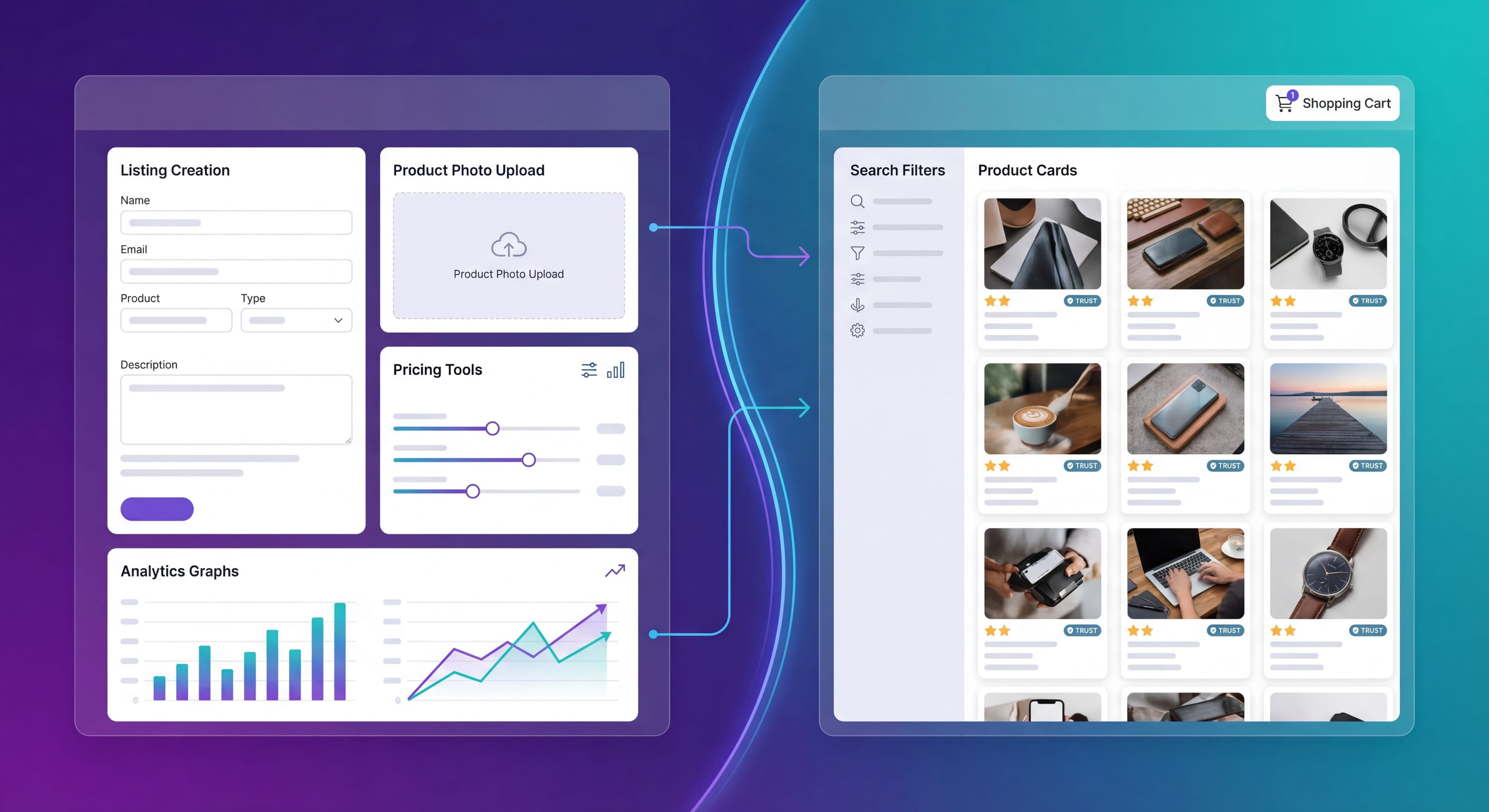

Marketplace onboarding is uniquely complex. You're not onboarding one type of user. You're onboarding two distinct sides with different needs, motivations, and success metrics. And each side's success depends on the other.
Here's how to design onboarding for two-sided marketplaces that activates both supply and demand effectively.
Seller onboarding overwhelming?
Create step-by-step guides that help sellers get listed and succeed faster with Glitter AI.
The Two-Sided Challenge
Marketplace Dynamics
The Chicken-and-Egg:
The fundamental challenge of marketplace onboarding is the circular dependency between supply and demand. Buyers arrive seeking products or services, but without active sellers offering quality inventory, they find nothing of value and leave. Sellers join hoping to reach customers, but without buyer traffic generating transactions, they see no return on their listing efforts and abandon the platform. This creates a precarious balance. About 30% of marketplace startups fail due to poor execution of this equilibrium, not from lack of market opportunity. According to recent platform economy research, marketplaces are deeply embedded in consumer habits, with 40.4% of U.S. online shopping journeys now starting on a marketplace rather than brand websites. Neither side will maintain engagement without the other actively participating. That makes simultaneous activation of both sides critical for survival.
Different User Types:
| Aspect | Supply Side (Sellers) | Demand Side (Buyers) |
|---|---|---|
| Goal | Earn money/find customers | Find products/services |
| Effort | High (create listings) | Low (browse/buy) |
| Stakes | Business/income | Transaction |
| Commitment | Long-term | Can be one-time |
| Activation | Complex | Simpler |
Why One Strategy Doesn't Work
Sellers Need:
Supply-side users need a fundamentally different onboarding approach focused on enablement and quality. They need a detailed setup process that walks them through profile creation, verification, and listing optimization since these foundational elements determine their success on the platform. Quality gates ensure that only legitimate, serious sellers enter the marketplace, protecting buyer trust and platform reputation. Trust gets established through identity verification, business documentation, and initial performance monitoring that builds confidence on both sides. Finally, sellers need tools to succeed including analytics dashboards, pricing guidance, customer communication systems, and performance tracking. Research shows platforms offering flexible onboarding and payout schedules see 20% higher seller retention.
Buyers Need:
Demand-side users prioritize speed and simplicity in their onboarding journey. They need quick value discovery, ideally within seconds of arrival, to confirm the marketplace has what they're looking for before investing effort in account creation. Low friction access lets them browse freely, evaluate options, and build confidence before committing to registration or purchase. Trust in sellers comes from visible verification badges, ratings, reviews, and platform protection policies that reduce perceived risk. Easy transactions with transparent pricing, multiple payment options, and clear delivery expectations complete the buyer experience. According to PwC Consumer Insights 2024, 71% of global consumers now prefer shopping on marketplaces rather than individual brand websites because of these advantages in price transparency, convenience, and trust.
Same marketplace, completely different onboarding approaches required to serve these distinct user needs.
Supply Side Onboarding (Sellers)
Seller Onboarding Goals
For the Marketplace:
Platform operators must focus onboarding efforts on building a healthy supply ecosystem. Quality inventory that meets buyer expectations and marketplace standards forms the foundation of trust and repeat usage. Active, reliable sellers who respond promptly, fulfill orders consistently, and maintain high performance standards create the operational excellence buyers expect. Compliance with policies around prohibited items, transaction integrity, and community standards protects the platform from legal and reputational risks. Competitive pricing relative to alternatives keeps buyers engaged and prevents seller race-to-the-bottom dynamics that erode marketplace value. Most two-sided marketplaces charge commission rates between 5% and 25% depending on industry and transaction value. Ensuring sellers can price profitably while remaining competitive is essential for sustainable economics.
For the Seller:
Individual sellers measure onboarding success through personal milestones that validate their platform investment. First sale represents activation, the moment when a seller transitions from setup to active participation and sees tangible return on their listing efforts. Understanding how to succeed through knowledge of platform algorithms, pricing strategies, customer service best practices, and optimization techniques determines long-term viability. Trust in the platform develops through transparent policies, reliable payment processing, fair dispute resolution, and responsive support when issues arise. Tools to manage business including inventory tracking, customer communication, analytics, and financial reporting enable sellers to operate efficiently and scale their marketplace presence. In 2026, the success of any digital marketplace hinges on its supply strategy. Onboarding serves as the front door to seller activation and enablement.
The Seller Journey
Application → Verification → Profile Setup →
Listing Creation → First Visibility → First Sale → Active Seller
Application and Verification
Balancing Access vs Quality:
Too Easy:
Low-quality sellers flood marketplace, hurt buyer trust.
Too Hard:
Not enough supply, marketplace fails.
Tiered Approach:
Tier 1: Basic Verification
- Email confirmation
- Phone verification
- Identity check
→ Can list with limitations

Tier 2: Standard Verification
- Business information
- Tax documentation
- Payment setup
→ Full listing access

Tier 3: Premium/Verified
- Additional vetting
- Track record review
- Enhanced visibility
→ Premium placement
Profile Setup
Essential Elements:
- Business/seller name
- Description/bio
- Profile photo/logo
- Contact information
- Location/service area
- Verification badges
Guided Setup:
Let's set up your seller profile.

Step 1 of 4: About You
Tell buyers who you are.
[Name] [Description] [Photo]

Step 2 of 4: Your Business
What do you offer?
[Categories] [Specialties]

Step 3 of 4: Location
Where do you operate?
[Address] [Service area]

Step 4 of 4: Verification
Build trust with buyers.
[ID verification] [Business docs]
First Listing Creation
Critical Moment:
First listing quality predicts seller success.
Guided Listing Flow:
Create Your First Listing

Step 1: Photos
Good photos get 3x more views.
[Upload] [Tips for great photos]

Step 2: Title & Description
Be specific and honest.
[Title] [Description]
💡 "Vintage Oak Dining Table" > "Table for sale"

Step 3: Pricing
Research similar listings: $150-$200
[Your price: $____]

Step 4: Details
[Category] [Condition] [Shipping]

[Preview] [Publish]
Quality Checks:
- Photo quality requirements
- Description length minimums
- Required fields completed
- Policy compliance check
Seller Education
What Sellers Need to Know:
Good seller education transforms raw signups into successful, active participants who drive marketplace growth. Understanding how the platform works includes navigation, feature discovery, algorithm mechanics that determine listing visibility, and the buyer journey from search to purchase. Creating effective listings requires knowledge of photography best practices, compelling copywriting, keyword optimization for searchability, and structured data entry that highlights product attributes. Pricing competitively means understanding market research tools, commission structures, dynamic pricing strategies, and competitor positioning within the marketplace. Handling transactions covers order processing workflows, shipping procedures, customer communication protocols, and return management that maintains positive ratings. Platform policies and requirements covering prohibited items, intellectual property rights, dispute resolution processes, and performance standards keep sellers in good standing. Tips from successful sellers provide social proof and practical wisdom that accelerates the learning curve, showing newcomers that success is achievable.
Delivery Methods:
Modern marketplaces use multi-channel education strategies to accommodate different learning preferences and engagement patterns. In-app guides and tooltips provide contextual, just-in-time help when sellers encounter features or decision points during their workflow. Email drip campaigns deliver sequenced education over days and weeks, reinforcing key concepts and prompting action at optimal moments in the seller journey. Video tutorials demonstrate complex processes visually and work particularly well for listing creation, photography, and platform tool usage. A seller handbook or knowledge base serves as reference documentation searchable by topic, offering depth for sellers seeking specific answers. Seller community forums enable peer-to-peer learning, sharing of tactics, and social connection that increases platform stickiness and surfaces organic best practices from those achieving results.
First Sale Activation
Supporting First Sale:
Marketplace platforms can actively accelerate seller activation by systematically supporting their path to first sale. Visibility boosts for new listings through temporary algorithmic favoritism ensure new sellers gain initial exposure despite lacking the review history and sales metrics that typically drive organic discovery. Promotional placement in "new arrivals," "fresh finds," or similar curated sections directs buyer attention to recently added inventory and creates discovery opportunities. "New seller" badges signal freshness and opportunity to buyers while setting appropriate expectations around limited transaction history. They protect new sellers from unfair comparison with established merchants. Notifications when listings get traction through favorites, views, or buyer questions provide positive reinforcement and prompt sellers to respond quickly, building momentum toward conversion. Drop-off is particularly damaging in marketplaces because adoption only works when both sides activate at the same pace. These first-sale support mechanisms significantly improve the critical early-stage funnel.
Celebrating Success:
🎉 Congratulations! Your first sale!

[Buyer Name] purchased [Item].

Next steps:
1. [Confirm and ship]
2. [Request review after delivery]

Seller tips:
• Respond to messages quickly
• Ship promptly for great reviews
• List more items to keep momentum

[View Order Details]
Demand Side Onboarding (Buyers)
Buyer Onboarding Goals
For the Marketplace:
- First transaction
- Return usage
- Trust in marketplace
- Minimal support burden
For the Buyer:
- Find what they need
- Trust in sellers
- Easy transaction
- Good experience
The Buyer Journey
Discovery → Browse → Interest → Transaction →
Delivery/Service → Review → Return
Low-Friction Entry
Buyers Need Quick Access:
- Browse without account
- Minimal signup when needed
- Social login options
- Guest checkout if appropriate
Progressive Registration:
[Browse freely - no account]
           ↓
[Save favorite - create account or continue as guest]
           ↓
[Make purchase - account required]
           ↓
[Leave review - logged in]
First Session Experience
Guide Discovery:
Welcome to [Marketplace]! 👋

What are you looking for today?

[Category 1] [Category 2] [Category 3]
[Browse all] [Search]

Or check out:
🔥 Popular right now
⭐ Top rated
🆕 New arrivals
Personalization:
What interests you?

Select a few to personalize your experience:
[Electronics] [Home & Garden] [Fashion]
[Sports] [Collectibles] [Services]

[Skip for now]
Trust Building
For Buyers:
Trust-building mechanisms address the fundamental risk buyers perceive when transacting with unknown sellers through online platforms. Seller verification badges provide visual confirmation of identity checks, business legitimacy, and platform vetting, reducing uncertainty about counterparty reliability. Ratings and reviews aggregate past buyer experiences into quantifiable metrics and qualitative feedback that inform purchase decisions, with research showing that visible social proof dramatically increases conversion rates. Transaction history displays seller tenure, volume, and consistency, helping buyers differentiate established, proven sellers from newcomers. Buyer protection policies explicitly outline recourse mechanisms for non-delivery, misrepresentation, or quality issues, shifting perceived risk from buyer to platform and increasing willingness to transact. Secure payment processing through trusted third-party systems or platform escrow services protects financial information and provides transaction guarantees. These trust signals have become table stakes in 2026, with 71% of global consumers preferring marketplaces specifically because of these perceived advantages in transparency and security over individual brand websites.
Trust Signals:
Seller: John's Electronics
⭐ 4.8 (250 reviews)
- [x] Verified Seller since 2020
- [x] Fast Shipper
🛡️ Buyer Protection Eligible

[Message Seller] [Buy Now]
First Transaction
Smooth Purchase:
- Clear pricing
- Transparent fees
- Payment options
- Delivery estimates
- Order confirmation
Post-Purchase:
Order Confirmed! ✓

[Item Name]
Seller: [Name]
Estimated delivery: [Date]

Track your order:
[Track Package]

Questions?
[Contact Seller] [Contact Support]
Quality Gates
Why Quality Matters
Low Quality Sellers:
The consequences of inadequate quality control cascade through the entire marketplace ecosystem with devastating effects. Bad buyer experiences from misleading listings, poor communication, delayed shipments, or substandard products create immediate dissatisfaction and platform abandonment. Negative reviews compound the problem by warning future buyers away from both individual sellers and the platform itself, creating a public record of quality failures. Platform reputation damage extends beyond individual transactions as pattern recognition sets in, with buyers concluding the marketplace systematically allows low-quality sellers. Reduced buyer retention follows inevitably, as once-burned customers seek alternatives with stronger quality curation, creating a downward spiral where supply quality determines demand retention. Common friction points that contribute to this include feature bloat where users don't understand the first step, multi-step account setups requiring extensive certifications, burdensome KYC procedures with ID verification and background checks, and complicated payment setup requiring linked bank accounts and tax information.
Quality vs Growth:
Marketplace operators face a constant tension between growth velocity and quality maintenance. Too restrictive verification requirements, excessive documentation demands, lengthy approval processes, or strict performance thresholds create supply scarcity that leaves buyer needs unmet and marketplace shelves empty. Too permissive entry standards, minimal vetting procedures, absent quality monitoring, or lax enforcement allows fraudulent sellers, misleading listings, and poor service experiences that erode buyer trust and platform value. The optimal balance varies by marketplace category, competitive dynamics, and growth stage, but the principle remains constant—quality gates should screen for commitment and capability without creating unnecessary barriers that prevent legitimate sellers from participating. Research shows that clunky seller onboarding represents a major pain point for many marketplaces, directly impacting supply activation rates.
Quality Gate Design
Entry Gates:
What's required to become a seller?
Minimum Requirements:
- [x] Verified identity
- [x] Valid payment method
- [x] Accepted policies
- [x] Complete profile
Listing Gates:
What's required to publish?
Listing Requirements:
- [x] At least 1 photo
- [x] Title (10+ characters)
- [x] Description (50+ characters)
- [x] Price set
- [x] Category selected
- [x] No prohibited content
Performance Gates:
What maintains good standing?
Good Standing Requirements:
• Response rate > 90%
• On-time shipping > 95%
• Rating > 4.0
• Policy violations = 0
Knowledge stuck in silos?
Create step-by-step guides that share expertise across your entire team with Glitter AI.
Graduated Access
Reward Quality:
New Seller:
- 10 active listings max
- Standard placement

Established Seller (50+ sales):
- 100 active listings
- Better placement
- Promoted listings available

Top Seller (500+ sales, 4.8+ rating):
- Unlimited listings
- Priority placement
- Reduced fees
- Premium badge
Balancing Supply and Demand
The Cold Start Problem
Strategy Options:
The cold start problem represents the most existentially threatening challenge facing new marketplaces, requiring careful strategic choices about sequencing and resource allocation.
Supply First:
The supply-first approach focuses on building comprehensive inventory before significant buyer marketing begins. This strategy ensures that when buyers arrive through marketing efforts, they immediately discover abundant, relevant options that demonstrate marketplace value and justify continued engagement. The advantage lies in creating strong first impressions and high conversion rates from marketing spend, as buyers encounter a thriving marketplace rather than sparse offerings. However, the substantial downside involves seller abandonment during the inventory-building phase, as early sellers experience little to no transaction activity, receive no validation of their time investment, and lose confidence in platform viability before buyer traffic materializes. Sellers recruited early may churn entirely before the marketplace achieves liquidity, requiring constant re-recruitment and creating skepticism about platform longevity.
Demand First:
The demand-first strategy generates buyer interest, email lists, or registered users before aggressively recruiting sellers. This approach attracts sellers with demonstrated demand evidence, making the sales pitch easier and creating confidence in immediate transaction opportunities. Sellers can achieve early sales quickly if buyer demand is real and concentrated, validating their participation and encouraging active listing behavior. The critical vulnerability emerges when buyers arrive to find insufficient inventory, leading to immediate disappointment, rapid abandonment, and negative word-of-mouth that poisons future marketing efforts. Buyers acquired through paid channels who encounter empty marketplaces represent pure customer acquisition cost waste, as they churn before experiencing any value.
Simultaneous:
The simultaneous approach builds both supply and demand within tightly defined segments, creating miniature marketplaces that achieve balance before expanding. This strategy yields the most balanced growth dynamics, as supply and demand scale together within specific categories or geographies, creating sustainable momentum. However, this approach proves intensely resource-intensive, requiring dual acquisition engines, careful orchestration of both funnels, sophisticated segmentation infrastructure, and significantly more operational complexity than single-side focus. The simultaneous approach works best for well-funded marketplaces with experienced teams who can manage the additional complexity in exchange for more predictable, sustainable growth trajectories.
Concentration Strategy
Start Narrow:
Instead of broad marketplace, focus on specific:
- Geography (one city)
- Category (one type of product)
- Niche (specific audience)
Then Expand:
Once one segment works, expand to adjacent areas.
Subsidizing Sides
Subsidize Supply:
Strategic subsidization of the supply side can accelerate seller activation and retention during the critical early phases when organic demand remains insufficient to sustain seller engagement. Lowering seller fees initially or implementing graduated fee structures that start free and increase with volume reduces the financial barrier to entry and allows sellers to experiment with the platform before committing significant resources. Marketing support for listings through platform-funded promotion, featured placement, or external advertising extends reach beyond what individual sellers could achieve independently, demonstrating platform value through visibility and engagement. Guaranteed minimum income programs, referral bonuses, or time-limited stipends provide financial insurance that allows sellers to invest listing effort even before organic transactions materialize. These subsidies prove most effective when time-limited and tied to performance milestones, creating urgency while avoiding unsustainable burn rates that can't transition to organic economics.
Subsidize Demand:
Demand-side subsidization lowers buyer acquisition costs and accelerates transaction velocity, creating the activity sellers need to remain engaged. Buyer discounts through promotional codes, percentage-off offers, or free shipping reduce price sensitivity and encourage first purchases that establish buying patterns. First purchase promotions specifically target the activation moment, recognizing that buyers who complete one successful transaction demonstrate significantly higher lifetime value than those who browse without buying. Reduced transaction fees passed through to buyers as lower prices or absorbed by the platform create competitive pricing advantages against established alternatives. The challenge with demand subsidization lies in developing profitable unit economics once subsidies end, as buyers acquired through discounts may prove price-sensitive and churn when prices normalize to sustainable levels. The most successful marketplaces use demand subsidies strategically to achieve liquidity thresholds where network effects become self-sustaining.
Knowledge stuck in silos?
Create step-by-step guides that share expertise across your entire team with Glitter AI.
Measuring Marketplace Onboarding
Supply Metrics
Funnel:
Applications: 1,000
Verified: 800 (80%)
First listing: 600 (75%)
Listing live: 500 (83%)
First sale: 200 (40%)
Active 30 days: 150 (75%)
Quality:
- Average listing quality score
- Policy violation rate
- Seller rating distribution
- Support ticket rate
Demand Metrics
Funnel:
Visitors: 10,000
Registered: 2,000 (20%)
First search: 1,800 (90%)
First favorite: 800 (44%)
First purchase: 400 (50%)
Return purchase: 200 (50%)
Experience:
- Time to first purchase
- Transaction success rate
- Review submission rate
- NPS/satisfaction
Marketplace Health
Supply-Demand Balance:
- Listings per buyer
- Search result fullness
- Time to first match
- Conversion rate
Trust:
- Dispute rate
- Fraud rate
- Cancellation rate
- Average seller rating
Common Mistakes
Mistake 1: Same Onboarding for Both Sides
Problem: Treating sellers like buyers.
Fix: Distinct onboarding paths.
Mistake 2: No Quality Gates
Problem: Low-quality listings flood marketplace.
Fix: Minimum standards with graduated access.
Mistake 3: Ignoring Cold Start
Problem: Neither side finds value.
Fix: Concentrated launch, subsidize as needed.
Mistake 4: Friction-Free Selling
Problem: Anyone can list anything.
Fix: Verification and quality requirements.
Mistake 5: Forgetting Trust
Problem: Buyers don't trust sellers.
Fix: Verification, reviews, protection policies.
Marketplace Onboarding Patterns
Pattern 1: Uber-Style
Supply: Extensive verification, training required.
Demand: Minimal friction, instant use.
Works When: Quality control is critical.
Pattern 2: Etsy-Style
Supply: Easy entry, grow over time.
Demand: Moderate friction, account needed.
Works When: Supply is abundant, uniqueness matters.
Pattern 3: Airbnb-Style
Supply: Moderate verification, host standards.
Demand: Trust-focused, reviews essential.
Works When: High-stakes transactions.
Pattern 4: eBay-Style
Supply: Open access, reputation-based.
Demand: Low friction, buyer protection.
Works When: High volume, varied quality acceptable.
Buyers getting confused?
Document your marketplace process and help new buyers find value quickly with Glitter AI.
The Bottom Line
Marketplace onboarding requires thinking about two customers, not one. Success means activating both sides while maintaining quality that builds trust. It's a balancing act that requires constant optimization as the marketplace evolves.
Key Principles:
- Design separate paths for supply and demand
- Use quality gates to protect buyer experience
- Build trust through verification and reviews
- Start concentrated, then expand
- Measure both sides independently
The best marketplace onboarding creates a virtuous cycle: quality sellers attract buyers, satisfied buyers attract more sellers, and the marketplace grows.
Continue learning: B2B SaaS Onboarding and Measuring Onboarding ROI.
Frequently Asked Questions
How do you onboard sellers on a two-sided marketplace?
Seller onboarding requires verification and trust-building through identity checks, profile setup guidance, first listing creation with quality checks, education on platform success factors, and support through the first sale with visibility boosts and promotional placement.
What is the chicken-and-egg problem in marketplace onboarding?
Buyers need sellers to find value and sellers need buyers to find value, creating a circular dependency. Solve this by starting with a concentrated focus on one geography or category, subsidizing one side initially, and building both sides simultaneously in specific segments.
How should buyer and seller onboarding differ on a marketplace?
Sellers need detailed setup, quality gates, verification, and tools to succeed with high-effort, long-term commitment onboarding. Buyers need quick value discovery, low friction, trust signals, and easy transactions with minimal barriers to browsing and purchasing.
What quality gates should marketplaces implement for sellers?
Implement entry gates (verified identity, valid payment, policy acceptance), listing gates (minimum photo quality, description length, required fields), and performance gates (response rate above 90%, on-time shipping above 95%, minimum rating thresholds).
How do you measure marketplace onboarding success?
Track supply side metrics including application-to-first-sale conversion funnel and seller quality scores. Track demand side metrics including visitor-to-purchase conversion and return purchase rates. Monitor marketplace health through supply-demand balance, dispute rates, and average seller ratings.