Customer Success and Onboarding: The Critical Handoff
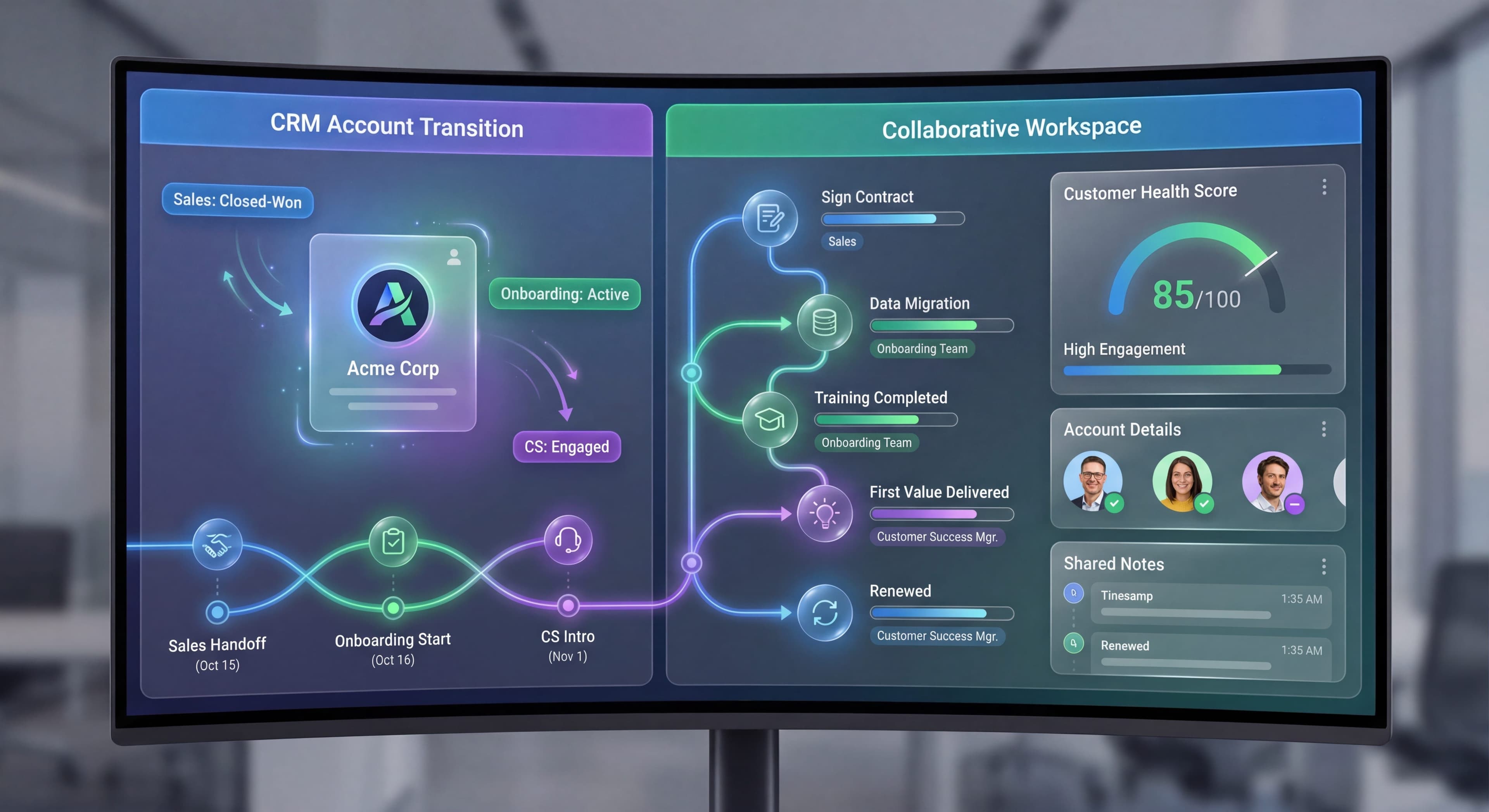

The most dangerous moments in a customer relationship are the handoffs. Sales closes the deal, then passes it to onboarding. Onboarding activates the user, then passes it to customer success. Each transition risks dropped context, broken expectations, and frustrated customers. The numbers are sobering: poor handoffs come up constantly as a top frustration in customer success, and up to 20% of churn links directly to handoff problems. When customers have to repeat information they already provided or get confused about who owns their relationship, trust erodes fast.
A smooth transition from sales to customer success sets the right tone and ensures relevant information actually gets passed along. The ideal moment for a sales-to-CS handoff is right after the deal is marked "Closed-Won," before onboarding begins. That makes the transition proactive instead of reactive. If the CSM lacks background information, their first conversations with the new account feel like an interrogation, asking questions the customer already answered during sales. That makes the company look disorganized and annoys customers who have to repeat themselves.
This guide covers how to design seamless handoffs that protect customer relationships, maintain context across transitions, and set up long-term success through clear processes and accountability.
Handoff process chaotic?
Create step-by-step guides that standardize your sales-to-CS handoffs and preserve customer context with Glitter AI.
The Handoff Problem
Why Handoffs Fail
Information Loss:
What sales learned about the customer doesn't reach onboarding.
What onboarding observed doesn't reach CS.
Expectation Gaps:
Sales promised X, but onboarding delivers Y.
Customer expected one thing, got another.
Relationship Reset:
Customer had rapport with sales, now starts over with stranger.
Timing Issues:
Handoff happens too early or too late.
Customer falls through cracks.
The Customer Experience
Bad Handoff:
Customer: "I already explained this to your sales rep."
Onboarding: "Can you tell me about your goals again?"
Customer: [Frustrated]
Good Handoff:
Onboarding: "Sarah mentioned you're focused on reducing
support tickets. Let me show you how we'll accomplish that."
Customer: "Yes! That's exactly what we need."
Business Impact
Failed Handoffs Cause:
- Extended time to value as customers re-explain their needs
- Lower activation rates from confusion and lost momentum
- Higher early churn when customers feel misunderstood
- Negative word of mouth about disorganized experiences
- Wasted acquisition cost when deals close but customers don't succeed
- More support tickets from preventable confusion
- Damaged customer confidence in the relationship
The Statistics:
- 69% of customer success teams own onboarding
- Poor handoffs consistently show up as a top frustration in surveys
- Up to 20% of churn links directly to handoff issues
- Seamless handoffs signal that your team is aligned and ready
- Zero drop-off between deal closing and onboarding kickoff builds customer confidence
The financial impact adds up fast. If you pay $5,000 to acquire a customer and lose 20% to handoff failures, that's $1,000 per customer lost to a completely preventable problem. Multiply that across hundreds of customers annually and poor handoffs cost organizations hundreds of thousands in wasted acquisition spend and lost lifetime value.
The Handoff Journey
Key Transitions
Sales → Onboarding → Customer Success
 ↓          ↓            ↓
Closes     Activates    Retains/Grows
deal       customer     relationship
Sales to Onboarding
What Needs to Transfer:
- Customer goals and pain points
- Use case and context
- Technical environment
- Decision makers and users
- Timeline expectations
- Promises made
- Red flags identified
Onboarding to Customer Success
What Needs to Transfer:
- Onboarding progress and completion
- Activation status
- Challenges encountered
- Key contacts and champions
- Feature adoption
- Potential expansion opportunities
- Support history
Information Transfer
Customer Record
Essential Data:
Customer Profile:
├── Company Information
│   ├── Industry
│   ├── Size
│   └── Tech stack
├── Stakeholders
│   ├── Decision maker
│   ├── Champion
│   ├── Users
│   └── IT contact
├── Goals
│   ├── Primary objective
│   ├── Success metrics
│   └── Timeline
├── Sales Context
│   ├── Why they bought
│   ├── Competitive evaluation
│   ├── Promises made
│   └── Concerns raised
├── Onboarding Status
│   ├── Setup completion
│   ├── Training done
│   ├── Activation metrics
│   └── Issues encountered
└── Expansion Potential
    ├── Additional use cases
    ├── More users
    └── Upgrade potential
Handoff Document/Notes
Sales to Onboarding Template:
Account: [Name]
Contract Details: [Plan, seats, term]
Primary Contact: [Name, role, email]

WHY THEY BOUGHT:
[Pain points and goals]

WHAT THEY EXPECT:
[Timeline, outcomes, specific features]

WHAT I PROMISED:
[Explicit commitments made]

RED FLAGS:
[Concerns, risks, difficult personalities]

KEY STAKEHOLDERS:
- [Name/Role] - [Notes]
- [Name/Role] - [Notes]

RECOMMENDED APPROACH:
[Suggestions for onboarding]
Systematizing Information Transfer
Standardized processes ensure consistency even as teams grow. Your sales team should summarize the customer's business size, needs, and KPIs, sharing it through your workspace so CS doesn't ask customers questions they already answered during sales.
In Your CRM:
Required fields before handoff (mandatory, not optional):
- Customer goals and pain points
- Key stakeholders with roles and contact info
- Specific promises made during sales
- Timeline expectations and go-live dates
- Technical environment and integration needs
- Budget and plan details
- Red flags or concerns identified
Handoff Checklist:
Before marking "ready for onboarding," sales must complete:
- All required CRM fields populated with real information
- Detailed handoff notes written covering customer context
- Internal sync meeting scheduled with onboarding team
- Customer introduction call or email scheduled
- Sales-specific documentation uploaded to shared location
- Competitive context noted if relevant
- Expansion opportunities flagged for later
CRM and workflow automation tools like Salesforce Flow or HubSpot Workflows can trigger tasks, emails, and reminders automatically as accounts move through onboarding stages. This removes manual handoffs and keeps everyone aligned on next steps, reducing the chance that critical information slips through cracks during busy periods.
Handoff Meetings
Internal Sync
Before Customer Handoff:
Sales and onboarding connect without customer.
Agenda:
- Customer overview (5 min)
- Goals and expectations (5 min)
- Stakeholder map (5 min)
- Concerns and sensitivities (5 min)
- Questions from onboarding (5 min)
- Handoff plan (5 min)
Customer Introduction
The Warm Handoff:
Sales introduces onboarding to customer directly.
Format Options:
Option 1: Email Introduction
Subject: Introducing [Onboarding Contact] - Your Success Partner

Hi [Customer],

I'm thrilled to hand you over to [Onboarding Contact], who will be
your guide through implementation.

[Onboarding Contact], meet [Customer]. They're focused on
[specific goal] and are excited to [specific outcome].

I'll leave you two to schedule your kickoff.

[Sales Rep]
Option 2: Joint Call
Sales joins first 5-10 minutes of kickoff.
- Introductions
- Context transfer (verbally)
- Sales exits, onboarding continues
Option 3: Video Message
Sales records brief personalized video for customer.
- Personal touch without scheduling
- Context in customer's words
- Onboarding follows up
Kickoff Meeting
Customer-Facing Kickoff:
Agenda:
- Introductions (5 min)
- Confirm understanding of goals (10 min)
- Onboarding plan overview (10 min)
- Timeline and milestones (5 min)
- Next steps and questions (10 min)
Key Moment:
Onboarding: "Based on our discussion with [Sales Rep], I understand
your primary goal is [goal]. Is that still accurate?"

Customer: "Yes, and also [additional context]"

Onboarding: "Great, let me note that. Here's how we'll get you there..."
Onboarding to CS Handoff
When to Hand Off
Trigger Options:
Milestone-Based:
Hand off when customer reaches defined state.
- Onboarding checklist complete
- Activation metrics met
- First value achieved
Time-Based:
Hand off after fixed period.
- 30 days post-signup
- End of implementation phase
- After go-live
Hybrid:
Whichever comes first, with flexibility.
CS Introduction
The Transition:
Onboarding: "Now that you're up and running, I'm introducing
[CS Manager] who will be your ongoing partner."

CS: "I've been following your progress. Congratulations on
[specific achievement]. I'm here to help you [next goal]."
What CS Needs to Know
From Onboarding:
Onboarding Summary:
- Setup completion: 100%
- Activation status: Achieved [date]
- Training completed: [list]
- Features adopted: [list]
- Outstanding items: [list]

Challenges Encountered:
- [Issue 1] - Resolved via [solution]
- [Issue 2] - Workaround in place

Customer Health:
- Sentiment: Positive/Neutral/Concerned
- Engagement: High/Medium/Low
- Risk factors: [any concerns]

Expansion Signals:
- Mentioned interest in [feature/plan]
- Could benefit from [add-on]
- Growing team may need more seats

Key Relationships:
- Champion: [Name] - [notes]
- Power user: [Name] - [notes]
- Executive sponsor: [Name] - [notes]
Technology and Process
Training taking too long?
Create step-by-step guides that get users productive faster with Glitter AI.
CRM Integration
Salesforce Example:
Opportunity → Account → Implementation Record → Success Record

Data flows from Opportunity through each stage:
- Goals captured at Opportunity
- Visible to Implementation team
- Carried to Success record
- Complete history available
Handoff Automation
Trigger on Stage Change:
When Opportunity → Closed Won:
- Create Implementation record
- Notify onboarding team
- Send handoff reminder to sales
- Schedule kickoff invite

When Implementation → Complete:
- Create CS record
- Assign CSM
- Send introduction email
- Schedule transition call
Shared Dashboards
Cross-Team Visibility:
- Sales sees onboarding progress
- Onboarding sees sales context
- CS sees full history
- Everyone aligned on customer status
Shared Metrics
Handoff Quality Metrics
Measurement drives improvement. Find one or two metrics that emphasize collaboration between teams. An obvious example: incentivize your onboarding team on overall retention rate too. All post-sale teams should have retention as one of their measurements to create shared accountability.
Sales to Onboarding:
- Handoff documentation completeness score (% of required fields filled)
- Time from close to kickoff call (target: less than 5 business days)
- Customer-reported expectation alignment (post-kickoff survey)
- Internal handoff meeting completion rate
- Number of "unknown" responses in onboarding kickoff
- Re-work rate (% of deals needing additional sales clarification)
Onboarding to CS:
- Onboarding summary completeness score
- Activation status at handoff (% meeting defined criteria)
- Customer sentiment at handoff (NPS or satisfaction score)
- Outstanding items documentation quality
- Health score at transition
- Time to first CS engagement post-handoff
Create a feedback loop for continuous improvement. Keep soliciting feedback from customers at key onboarding touchpoints so you're taking the right actions throughout the customer lifecycle. Platforms like Gainsight, Totango, or ChurnZero provide health scoring, automated playbooks, and real-time alerts when customers show risk or expansion potential. This centralizes insights so teams can act quickly and consistently.
Customer Journey Metrics
End-to-End:
- Time from close to activation
- Time from close to expansion
- Net revenue retention by handoff quality
- Customer satisfaction by handoff experience
Feedback Loops
Post-Handoff Surveys:
To customer after onboarding kickoff:
"Did your onboarding team understand your goals from the start?"
To customer after CS introduction:
"Did your CS manager have context on your journey so far?"
Training taking too long?
Create step-by-step guides that get users productive faster with Glitter AI.
Common Patterns
Pattern 1: The Relay Race
Description:
Clear, defined handoffs like a relay race—baton must be passed cleanly.
Works When:
- Clear stages
- Different skills per stage
- Scaled operations
Risk:
Dropped batons (customers) at transitions.
Pattern 2: The Overlap Model
Description:
Teams overlap during transitions for smoother handoff.
Sales ─────────┐
               ├── Overlap ──┤
Onboarding ────┘             └── Overlap ──┤
                    CS ────────────────────┘
Works When:
- High-touch customers
- Complex implementations
- Resources allow
Risk:
Confusion about ownership.
Pattern 3: The Pod Model
Description:
Customer assigned to a pod with dedicated sales, onboarding, and CS.
Works When:
- Enterprise accounts
- Long relationships
- Team stability
Risk:
Resource intensive.
Pattern 4: The Single Owner
Description:
One person (usually CS) owns relationship from close to renewal.
Works When:
- Simpler products
- Shorter onboarding
- Generalist team
Risk:
Skill coverage gaps.
Common Mistakes
Mistake 1: No Documentation
Problem: Sales closes deal with no written context.
Fix: Required handoff documentation before close.
Mistake 2: Cold Handoffs
Problem: Customer introduced to new person with no warm intro.
Fix: Warm handoffs with sales introduction.
Mistake 3: Wrong Timing
Problem: Handoff happens before customer ready.
Fix: Milestone-based triggers.
Mistake 4: Lost Information
Problem: Each team uses different systems.
Fix: Integrated CRM with shared records.
Mistake 5: No Feedback
Problem: Teams don't know handoffs are failing.
Fix: Post-handoff surveys and metrics.
Handoff Checklist
Sales to Onboarding
Before Handoff:
- All handoff fields completed
- Handoff notes written
- Internal sync completed
- Customer intro scheduled
- Kickoff meeting booked
At Handoff:
- Warm introduction made
- Context transferred verbally
- Customer confirms understanding
- Questions addressed
Onboarding to CS
Before Handoff:
- Activation achieved
- Onboarding summary complete
- Outstanding items documented
- Health assessment recorded
- CS assignment made
At Handoff:
- CSM introduced
- Context provided
- Next steps clear
- Relationship transitioned
Context lost between teams?
Build SOPs that ensure customer information transfers smoothly from sales to success with Glitter AI.
The Bottom Line
Handoffs are where customer relationships succeed or fail. The difference between a frustrated customer and a happy one often comes down to context: knowing their goals, their history, their concerns.
Key Principles:
- Document everything that matters
- Warm introductions, not cold transfers
- Right timing based on customer readiness
- Shared systems for shared context
- Measure and improve handoff quality
The best handoff is one the customer barely notices. A seamless continuation of a relationship, not a disruptive restart.
Continue learning: Reducing Churn and Enterprise Onboarding.
Frequently Asked Questions
What information should transfer during a sales to onboarding handoff?
Critical information includes customer goals and pain points, use case context, technical environment, key stakeholders and decision makers, timeline expectations, specific promises made during sales, and any red flags identified.
How do you prevent customer frustration during onboarding transitions?
Prevent frustration by documenting everything that matters, using warm introductions rather than cold transfers, timing handoffs based on customer readiness, maintaining shared systems for context, and measuring handoff quality through post-handoff surveys.
What is a warm handoff in customer success?
A warm handoff is when the outgoing team member (like sales) personally introduces the customer to the incoming team member (like onboarding). This can be done via email introduction, joint call, or personalized video message to transfer context and build trust.
When should onboarding hand off to customer success?
Hand off when customers reach defined milestones such as completing the onboarding checklist, meeting activation metrics, or achieving first value. Time-based triggers (like 30 days post-signup) can supplement milestone-based handoffs.
What are common onboarding handoff mistakes to avoid?
Common mistakes include no documentation of customer context, cold handoffs without warm introductions, handing off before the customer is ready, using disconnected systems that lose information, and having no feedback loops to identify failing handoffs.