Reducing Churn Through Better Onboarding
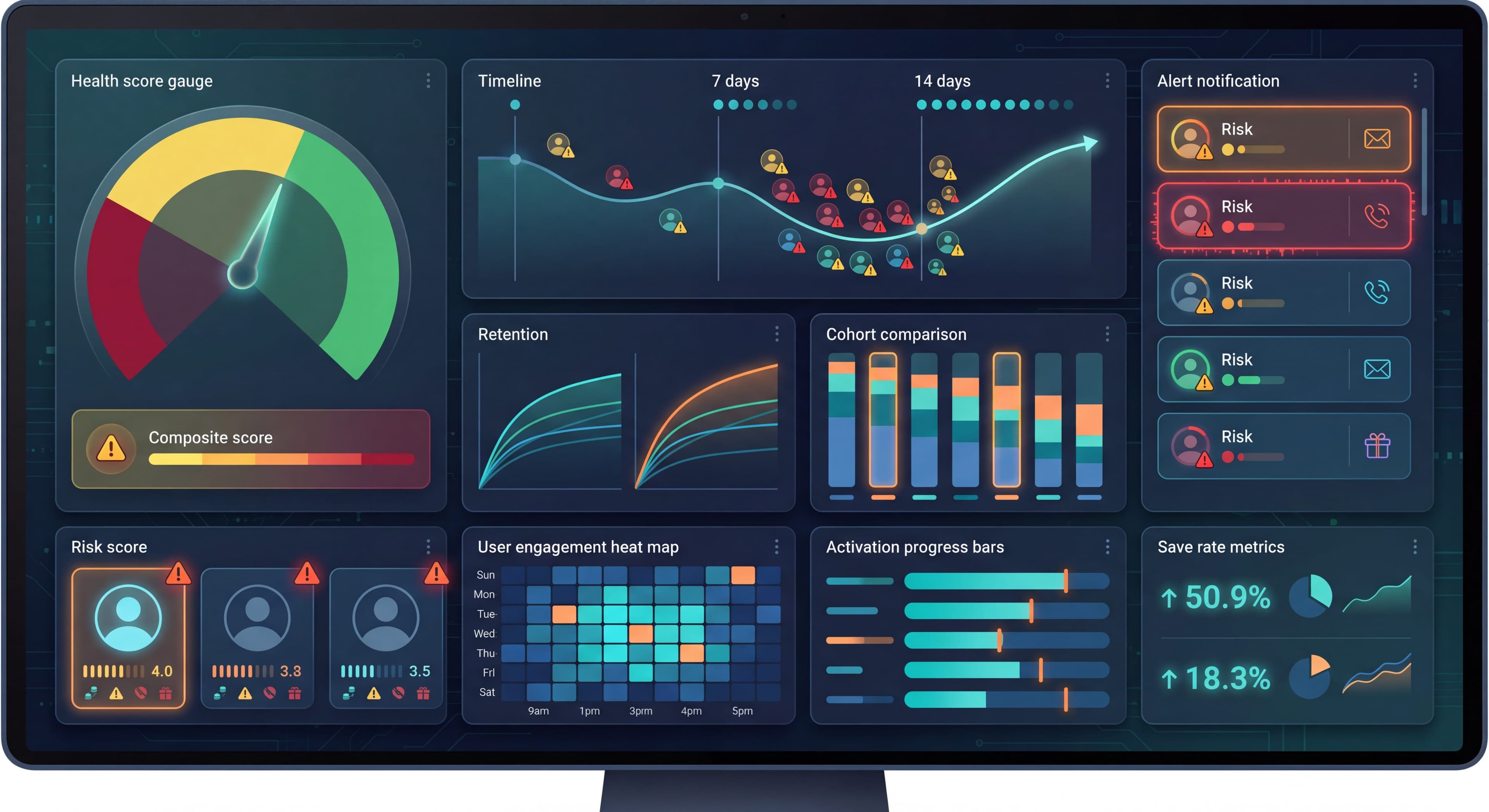

Poor onboarding is the top cause of early churn. Users who don't activate rarely come back. Users who don't experience value quickly see no reason to stay. By the time most companies notice churn, the damage was already done months earlier during onboarding.
This guide covers how to prevent churn before it happens by fixing the onboarding problems that drive users away.
Users leaving too soon?
Create step-by-step guides that help users find value before they churn with Glitter AI.
The Onboarding-Churn Connection
When Churn Actually Begins
Understanding when churn starts means recognizing the disconnect between when users mentally abandon products versus when that abandonment shows up in your metrics. The timeline is sobering. Users sign up on Day 1 with optimism, but by Day 3 many have already failed to activate, experiencing a disappointing session that plants seeds of doubt about whether this product is worth continued effort. That Day 3 failure is the true beginning of churn, even though the user hasn't officially churned and may even log in sporadically over the following weeks out of guilt rather than genuine engagement.
By Day 14, when the trial ends, these psychologically-churned users just formalize their exit by not converting to paid. The company finally counts them as churned at Day 30 when they show up in monthly reports, but the actual failure happened 27 days earlier during those critical first sessions. The tragedy is that most intervention happens at Day 14 or later, with desperate last-minute outreach offering discounts or promising improvements, when psychological commitment has already evaporated. Effective intervention needs to happen at Day 1-7 when users still have goodwill, curiosity, and willingness to invest effort. That early window is the highest-leverage opportunity for churn prevention.
The Numbers
The evidence supporting onboarding's role in churn prevention is consistent across industries. Research shows 40-60% of trial users never return after their first session. Initial experiences make or break long-term relationships before companies even realize these users were at risk. Over 50% of churn can be traced back to poor onboarding, making it the single largest controllable driver of customer loss. Users who don't activate in the first week rarely activate later. Early retention from Day 1-7 strongly predicts long-term patterns. Poor onboarding is the top reason for early churn, ahead of product-market fit issues, pricing concerns, or competition.
The business impact of fixing onboarding-driven churn is just as significant. Companies that get onboarding right can reduce churn by 45% or more, transforming retention economics dramatically. Reducing churn by just 5% can increase profits by 25-95%, showing the multiplier effect of retention improvements on the bottom line. It costs 5-25x more to acquire new customers than to keep existing ones, making churn reduction through better onboarding one of the highest-ROI activities product teams can take on. With high churn rates, companies not only lose recurring revenue but must spend disproportionately on acquisition just to maintain steady customer counts, creating resource drains that starve investment in product improvement.
Root Causes of Onboarding Churn
Understanding why users abandon products during onboarding means recognizing six failure patterns that show up consistently across industries. Users who didn't understand value represent the most common failure. They signed up based on marketing promises or recommendations but never experienced concrete, personal benefits that would justify continued usage. They might technically understand what features exist but never internalized how those features would improve their workflows or solve their problems. The disconnect between abstract capability and personal relevance kills these relationships before they really start.
Complexity overwhelms users who encounter products demanding too much cognitive effort, learning, or configuration before delivering value. These users arrive ready to invest reasonable effort but get buried under lengthy setup wizards, confusing interfaces, or workflows requiring them to master multiple concepts at once. When perceived effort exceeds perceived value, rational users leave regardless of the product's ultimate potential. This hits sophisticated B2B tools especially hard, products that offer immense power but present it through interfaces that intimidate rather than invite exploration.
Technical and process barriers block users who want to succeed but hit obstacles beyond their control. Integration requirements demand technical knowledge they don't have. SSO configuration requires IT involvement that creates delays. Data migration proves more complex than expected. Required permissions and approvals stall progress indefinitely. These users often stay engaged psychologically but can't complete activation despite genuine effort, building frustration that eventually exhausts their patience.
Lack of guidance leaves users alone at critical moments when they need clear next steps or direction. After signup, they face empty states without obvious actions, unclear prioritization when many options exist, or simply don't know what success looks like in the product. Without explicit guidance about recommended first actions or expected progression, users wander aimlessly, experiment randomly, and conclude the product isn't for people like them. This especially affects products with multiple use cases where the "obvious" path varies by user type.
Wrong-product realization happens when users discover mismatches between their needs and actual capabilities, often due to marketing that oversold, sales processes that didn't qualify fit carefully, or genuine evolution in requirements between purchase and implementation. While some wrong-product churn is inevitable, excessive rates suggest messaging or targeting problems. Time scarcity defeats users with good intentions who never prioritize learning amid competing demands, repeatedly deferring until their trial expires. They may genuinely want to use the product but never allocate enough focused time to overcome initial learning curves.
Identifying At-Risk Users
Early Warning Signals
Day 1 Indicators:
- Didn't complete signup flow
- Left during onboarding
- No meaningful actions
- Short session duration
Day 3 Indicators:
- No return visit
- No email engagement
- Incomplete setup
- Only surface-level usage
Day 7 Indicators:
- Still not activated
- Declining engagement
- Help-seeking without resolution
- Critical features unused
Building an At-Risk Score
Scoring Model:
Risk Factor                    Points
------------------------------------------
No login Day 1-3               +30
Didn't complete onboarding     +20
No activation behaviors        +25
Declining engagement trend     +15
Help-seeking without success   +10
Similar users churned          +15

Low Risk: 0-30
Medium Risk: 31-60
High Risk: 61+
Segmenting Risk
Combine Risk Level with Value:
| Value | Risk | Action |
|---|---|---|
| High | High | Personal outreach |
| High | Low | Monitor, light touch |
| Low | High | Automated intervention |
| Low | Low | Standard flow |
Intervention Strategies
Automated Interventions
Re-engagement Emails:
Subject: Need help getting started?

Hi [Name],

I noticed you signed up but haven't had a chance
to set things up. Getting started takes about
5 minutes.

Here's the quickest path to value:
1. [First step]
2. [Second step]
3. [Third step]

[Start Now →]

Questions? Just reply to this email.
In-App Prompts:
When user returns, surface targeted guidance based on where they stopped.
Push Notifications:
For mobile apps, reminder with specific value hook.
High-Touch Interventions
Personal Outreach:
For high-value accounts, direct email or call.
Screen Share Assistance:
Offer to walk through setup together.
Custom Resources:
Record personalized video showing their specific use case.
Intervention Timing
Immediate (Day 0-1):
- Follow-up email if didn't activate
- In-app guidance for stuck users
- Chat offer during session
Early (Day 2-4):
- Re-engagement sequence begins
- Alternative onboarding paths offered
- Check-in email
Critical (Day 5-7):
- Escalated outreach for high-value
- "We miss you" campaigns
- Limited-time incentives if appropriate
Late (Day 8-14):
- Final trial reminders
- Data preservation warnings
- Last-chance engagement
Fixing Onboarding Problems
Problem: Users Don't Understand Value
Symptoms:
- Low engagement despite signup
- Quick abandonment
- No activation behaviors
Solutions:
- Clearer value proposition at signup
- Faster time to first value
- Better first-time experience
- Value-focused onboarding copy
Problem: Too Complicated
Symptoms:
- High drop-off during setup
- Help-seeking early
- Incomplete configurations
- Rage clicks, frustration signals
Solutions:
- Simplify signup and setup
- Progressive disclosure
- Smart defaults
- Template-based quick starts
Training taking too long?
Create step-by-step guides that get users productive faster with Glitter AI.
Problem: No Clear Next Steps
Symptoms:
- Users wander without direction
- Low checklist completion
- Random feature exploration
- Session ends without action
Solutions:
- Clear onboarding checklist
- Prominent next-step guidance
- Empty state improvements
- Contextual prompts
Problem: Technical Barriers
Symptoms:
- Drop-off at integration steps
- Error-related abandonment
- Support tickets about setup
- Incomplete technical setup
Solutions:
- Better error handling
- Setup assistance
- Alternative paths
- Technical support availability
Prevention vs. Recovery
Prevention (Preferred)
Goal: Users never become at-risk.
Approach:
- Excellent onboarding experience
- Quick time to value
- Clear guidance throughout
- Proactive support
Investment: Onboarding optimization
Recovery (Necessary)
Goal: Save users who've shown risk signals.
Approach:
- Early warning identification
- Targeted intervention
- Re-engagement campaigns
- Personal outreach when warranted
Investment: Monitoring and intervention systems
The Ratio
For every dollar spent on recovery, consider spending three on prevention. It's more efficient to prevent churn than to recover churned users.
Measuring Impact
Key Metrics
Leading Indicators:
- Day 1 activation rate
- Day 7 retention rate
- Onboarding completion rate
- Time to first value
Lagging Indicators:
- Trial conversion rate
- 30-day churn rate
- Net revenue retention
- Customer lifetime value
Attribution
Tracking Intervention Impact:
- Cohort comparison (intervened vs. not)
- Before/after analysis
- A/B testing of interventions
- Segment analysis
ROI Calculation
Example:
Intervention: Personal outreach to at-risk high-value users
Cost: $50 per user (time + tools)
Users intervened: 100
Saves: 20 users (20% recovery rate)
LTV of saved users: $5,000 average
Revenue saved: 20 × $5,000 = $100,000
Cost: 100 × $50 = $5,000
ROI: 20x
Users confused at signup?
Create onboarding guides that eliminate confusion and drive activation with Glitter AI.
Building a Churn Prevention System
Phase 1: Visibility
- Define at-risk criteria
- Set up tracking
- Build risk scoring
- Create dashboards
Phase 2: Automation
- Design intervention triggers
- Build email sequences
- Create in-app prompts
- Set up notifications
Phase 3: Process
- Define response procedures
- Assign ownership
- Create escalation paths
- Train team
Phase 4: Optimization
- Measure intervention effectiveness
- Iterate on timing and content
- Refine risk scoring
- Improve prevention (onboarding fixes)
Training taking too long?
Create step-by-step guides that get users productive faster with Glitter AI.
Team Responsibilities
Product Team
- Onboarding experience quality
- In-app intervention implementation
- Analytics and tracking
- User experience improvements
Customer Success
- High-value intervention
- Personal outreach
- Usage monitoring
- Feedback collection
Marketing
- Email sequences
- Re-engagement campaigns
- Content for education
- Segmentation support
Sales
- Trial conversion assistance
- Expansion opportunity from saves
- Feedback on objections
- High-value account attention
Common Mistakes
Mistake 1: Intervention Too Late
Problem: Waiting until trial end to engage.
Fix: Early warning systems, Day 1-7 intervention.
Mistake 2: Generic Outreach
Problem: Same message to all at-risk users.
Fix: Segment-specific, context-aware messaging.
Mistake 3: Aggressive Tactics
Problem: Pushy sales approach to at-risk users.
Fix: Help-first, value-focused engagement.
Mistake 4: No Root Cause Fix
Problem: Only treating symptoms, not causes.
Fix: Use at-risk data to improve onboarding.
Mistake 5: Ignoring Small Accounts
Problem: Only intervening with enterprise.
Fix: Scaled automation for all account sizes.
The Long-Term View
Churn Prevention as Culture
Not Just a Process:
Churn prevention should be embedded in how you build product, not just how you recover users.
Every Feature Decision:
- Does this make onboarding easier?
- Does this help users succeed faster?
- Does this reduce friction?
Compounding Returns
Better Onboarding:
- Lower early churn
- Higher activation
- Better word of mouth
- More efficient growth
Each Improvement:
Compounds over time as more cohorts benefit.
The Bottom Line
The best churn prevention happens before users become at-risk. Great onboarding creates activated users who never think about leaving. But for users who do struggle, early identification and timely intervention can save significant revenue.
Key Principles:
- Churn begins during onboarding, not at renewal
- Early warning systems catch at-risk users in time
- Intervention must be timely and relevant
- Prevention is more efficient than recovery
- Use churn data to improve onboarding itself
The goal isn't just saving users who are about to churn. It's making onboarding so good that users never become at-risk in the first place.
Continue learning: Activation Rate and Onboarding Emails.
Frequently Asked Questions
How does poor onboarding cause early churn in SaaS?
Poor onboarding is the leading cause of early churn because 40-60% of trial users never return after their first session. Users who fail to activate in the first week rarely activate later. By the time most companies notice churn at renewal, the actual failure happened during onboarding when users did not understand value or got overwhelmed.
What are early warning signals of at-risk users?
Day 1 indicators include not completing signup, leaving during onboarding, no meaningful actions, and short sessions. Day 3 signals are no return visit, no email engagement, and incomplete setup. Day 7 warning signs include still not activated, declining engagement, help-seeking without resolution, and critical features unused.
How do you build an at-risk user scoring model for churn prevention?
Assign risk points to behaviors like no login in days 1-3, incomplete onboarding, no activation behaviors, declining engagement trends, and unsuccessful help-seeking. Combine risk level with user value to prioritize responses: high-value at-risk users get personal outreach while low-value at-risk users receive automated interventions.
When should you intervene with at-risk users to prevent onboarding churn?
Intervene immediately on days 0-1 with follow-up emails and in-app guidance. During days 2-4, start re-engagement sequences and offer alternative onboarding paths. Days 5-7 require escalated outreach for high-value users. Days 8-14 are for final trial reminders and last-chance engagement before users are typically lost.
Is preventing churn more effective than recovering churned users?
Prevention is significantly more efficient than recovery. For every dollar spent on recovery, consider spending three on prevention through better onboarding. Excellent onboarding creates activated users who never become at-risk, while recovery interventions require resources to identify, reach, and re-engage users who have already disengaged.